A crocodile is any species belonging to the family Crocodylidae (sometimes classified instead as the subfamily Crocodylinae). The term can also be used more loosely to include all members of the order Crocodilia: i.e. the true crocodiles, the alligators and caimans (family Alligatoridae) and the gharials (family Gavialidae), or even the Crocodylomorpha which includes prehistoric crocodile relatives and ancestors. Crocodiles are large aquatic reptiles that live throughout the tropics in Africa, Asia, the Americas and Australia. Crocodiles tend to congregate in freshwater habitats like rivers, lakes, wetlands and sometimes in brackish water. They feed mostly on vertebrates like fish, reptiles, and mammals, sometimes on invertebrates like mollusks and crustaceans, depending on species. They are an ancient lineage, and are believed to have changed little since the time of the dinosaurs. They are believed to be 200 million years old, dinosours became extinct 65 million years ago. So crocodiles survived great extinction events. However, their teeth can be up to 5 inches in length.
Contents
Description
Crocodiles, like dinosaurs, have the abdominal ribs modified into gastralia
Crocodiles are among the more biologically complex reptiles despite their prehistoric look. Unlike other reptiles they have a four-chambered heart, diaphragm and cerebral cortex. Their external morphology on the other hand is a sign of their aquatic and predatory lifestyle. A crocodile’s physical traits allow it to be a successful predator. They have a streamlined body that enables them to swim faster. They also tuck their feet to their sides while swimming, which makes the animal faster by decreasing water resistance. They have webbed feet which, although not used to propel the animal through the water, allow it to make fast turns and sudden moves in the water or initiate swimming. Webbed feet are an advantage in shallower water where the animals sometimes move around by walking.
Crocodiles are very fast over short distances, even out of water. They have extremely powerful jaws capable of biting down with immense force, by far the strongest bite of any animal. The crocodile's bite force is more than 5,000 pounds per square inch, comparing to just 335 psi for a rottweiler, 400 psi for a large great white shark, or 800 to 1,000 psi for a hyena. They have sharp teeth for tearing and holding onto flesh, but cannot open their mouth if it is held closed. Since crocodiles feed by grabbing and holding onto their prey, they have evolved powerful muscles that close the jaws and hold them shut. The jaws are opened, however, by a very weak set of muscles. Zoologists will often subdue crocodiles for study or transport by taping their jaws or holding their jaws shut with large rubber band cut from automobile inner tubes. All crocodiles have sharp and powerful claws. They have limited lateral movement in their neck, so on land, protection can be found by getting even a small tree between the crocodile's jaws and oneself.
Age
There is no reliable way of measuring crocodile age, although several techniques are used to derive a reasonable guess. The most common method is to measure lamellar growth rings in bones and teeth - each ring corresponds to a change in growth rate which typically occurs once a year between dry and wet seasons. Bearing these inaccuracies in mind, the oldest crocodilians appear to be the largest species. C. porosus is estimated to live around 70 years on average, and there is limited evidence that some individuals may exceed 100 years. One of the oldest crocodiles recorded died in a zoo in Russia apparently aged 115 years.
A male freshwater crocodile at the Australia Zoo is estimated to be 130 years old. He was rescued from the wild by Bob Irwin and Steve Irwin after being shot twice by hunters. As a result of the shootings, this crocodile (known affectionately as "Mr. Freshy") has lost his right eye.
Size
Large Crocodile in captivity in Australia
Size greatly varies between species, from the dwarf crocodile to the enormous saltwater crocodile. Large species can reach over 5m (16 ft) long and weigh well over 1200 kg (2,640 lb). Despite their large adult size, crocodiles start their life at around 20 cm (8 inches) long. The largest species of crocodile is the saltwater crocodile, found in northern Australia and throughout south-east Asia.
The largest recorded crocodile is a giant saltwater crocodile measured at 8.6 meters (28.2 feet) shot in Australia, by a school teacher who later became a conservationist. The largest living crocodile is a 7.1 m (25.3 ft) long saltwater crocodile, in Orissa, India. It lives in Bhitarkanika Wildlife Sanctuary and in June 2006, was entered in the Guinness Book of World Records.
The other two larger certifiable records are both of 6.2 m crocodiles. The first crocodile was shot in the Mary River in the Northern Territory of Australia in 1974 by poachers and measured by wildlife rangers. The second crocodile was killed in 1983 in the Fly River, Papua New Guinea. In this latter crocodile it was actually the skin that was measured by zoologist Jerome Montague, and as skins are known to underestimate the size of the actual animal, it is possible this crocodile was at least another 10 cm longer.
Sweetheart, a large saltwater crocodile that attacked boats
The largest crocodile ever held in captivity is an Estuarine/Siamese hybrid named Yai (Thai: ใหญ่, meaning big) (born 10 June, 1972) at the famous Samutprakarn Crocodile Farm and Zoo, Thailand. This animal measures 6 m (19 feet) in length and weighs 1,114.27 kg (2,450 lb.).
Another huge captive specimen was a salt water crocodile named Gomek. Gomek was captured by George Craig in Papua New Guinea and sold to St. Augustine Alligator Farm in Florida, USA. Gomek died of heart disease in February 1997. When he died, he was 5.5 m long - as confirmed by St. Augustine Alligator Farm - and probably between 70 and 80 years old.
Yet another enormous crocodile, named Gustave by the Africans who have seen him, is responsible for over 300 human deaths, and allegedley ate an entire hippopotamus. He also starrs in a film, titled Primeval. The crocodile's length is said to be anywhere between 20-30 feet long. He lives along the Ruzizi River in Africa.
Wildlife experts, however, argue that the largest crocodile so far found in the Bhitarkanika was almost 7.62 m which could be traced from the skull preserved by the Kanika Royal Family. The crocodile was shot near Dhamara in 1926 and later its skull was preserved by the then Kanika King. Crocodile experts estimate the animal at about 7.62 m long since the size of the skull was measured one seventh of the total length of the body.
A statue of Saint Theodore of Amasea treading on a crocodile (Venice, Italy)
Etymology
The crocodile gets its name from the Greeks who observed them in the River Nile. The Greeks called them krokodilos, a compound word from kroke, which means "pebble" and drilos, which means "worm". To the Greeks, this "worm of the stones" was so named because of the crocodiles habit of basking in the sun on gravel-covered river banks.
Petsuchos was the name given by the Greeks to a live crocodile at Crocodilopolis in Ancient Egypt, which was worshipped as a manifestation of the Egyptian god Sobek; the deification of crocodiles.
During a voyage in 1585-1586, Sir Francis Drake named the Cayman Islands after the islands' 10-foot crocodiles, called "caymanas" by the native Caribs.
Biology and behaviour
Crocodiles are ambush hunters, waiting for fish or land animals to come close, then rushing out to attack. As cold-blooded predators, they are lethargic, therefore survive long periods without food, and rarely need to actively go hunting. Despite their slow appearance, crocodiles are top predators in their environment, and various species have been observed attacking and killing sharks. A famous exception is the Egyptian Plover which is said to enjoy a symbiotic relationship with the crocodile. According to unauthenticated reports, the plover feeds on parasites that infest the crocodile's mouth and the reptile will open its jaws and allow the bird to enter to clean out the mouth (Richford and Mead 2003).
Crocodile farm in Mexico
Crocodiles eat fish, birds, mammals and occasionally smaller crocodiles.
Crocodiles are protected in many parts of the world, but they also are farmed commercially. Their hide is tanned and used to make leather goods such as shoes and handbags, whilst crocodile meat is also considered a delicacy. The most commonly farmed species are the Saltwater and Nile crocodiles, while a hybrid of the Saltwater and the rare Siamese crocodile is also bred in Asian farms. Farming has resulted in an increase in the Saltwater crocodile population in Australia, as eggs are usually harvested from the wild, so landowners have an incentive to conserve crocodile habitat.
Crocodiles are more closely related to birds and dinosaurs than to most animals classified as reptiles, the three being included in the group Archosauria ('ruling reptiles'). See Crocodilia for more information.
Crocodile embryos do not have sex chromosomes, and unlike humans sex is not determined genetically. Sex is determined by temperature, with males produced at around 31.6 degrees celsius, and females produced at slightly lower and higher temperatures. The average incubation period is around 80 days, and also is dependent upon temperature.
It has been observed that crocodiles may possess a form of homing instinct.Three rogue saltwater crocodiles were relocated 400 kilometres by helicopter in northern Australia but had returned to their original locations within three weeks, based on data obtained from tracking devices attached to the reptiles.
The land speed record for a crocodile is 17 kph (10.6 mph) measured in a galloping Australian freshwater crocodile. Maximum speed varies from species to species. Certain types of crocodiles can indeed gallop, including Cuban crocodiles, New Guinea crocodiles, African dwarf crocodiles and even smaller Nile crocodiles. For most species, the fastest they can move is a kind of "belly run," where the body moves in a snake-like fashion, limbs splayed out to either side paddling away frantically while the tail whips to and fro. Crocodiles can reach speeds of 10 or 11 kph (around 7 mph) when they "belly run," and often faster if they're slipping down muddy tidal riverbanks. It is possible for a human to outrun a crocodile; the best way to do so is to run in a straight line rather than zig-zagging back and forth.
Danger to humans
Main article: Crocodile attacks
The larger species of crocodiles are very dangerous to humans. The main danger that crocodiles pose is not their ability to run after a person but their ability to strike before the person can react. The Saltwater and Nile Crocodiles are the most dangerous, killing hundreds of people each year in parts of south-east Asia and Africa. Mugger crocodiles and possibly the endangered Black Caiman, are also very dangerous to humans. American alligators are less aggressive and rarely assault humans without provocation. The most deaths in a single crocodile attack incident may have occurred during the Battle of Ramree Island, on February 19, 1945, in Burma. Nine hundred soldiers of an Imperial Japanese Army unit, in an attempt to retreat from the Royal Navy and rejoin a larger battalion of the Japanese infantry, crossed through ten miles of mangrove swamps which contained Saltwater Crocodiles. Twenty Japanese soldiers were captured alive by the British, and almost five hundred are known to have escaped Ramree. Many of the remainder may have been eaten by the crocodiles, although gunfire from the British troops was undoubtedly a contributory factor. Mosquitos aside, crocodiles are the leading cause of animal related deaths as of 2001.
Thursday, February 21, 2008

Thursday, February 14, 2008
Crocodile #1
Scientific Classification
Nile Crocodile
Kingdom:
Animalia
Phylum:
Chordata
Class:
Sauropsida
Order:
Crocodilia
Family:
CrocodylidaeCuvier, 1807
Genera
Mecistops
Crocodylus
Osteolaemus
See full taxonomy.
A crocodile is any species belonging to the family Crocodylidae (sometimes classified instead as the subfamily Crocodylinae). The term can also be used more loosely to include all members of the order Crocodilia: i.e. the true crocodiles, the alligators and caimans (family Alligatoridae) and the gharials (family Gavialidae), or even the Crocodylomorpha which includes prehistoric crocodile relatives and ancestors. Crocodiles are large aquatic reptiles that live throughout the tropics in Africa, Asia, the Americas and Australia. Crocodiles tend to congregate in freshwater habitats like rivers, lakes, wetlands and sometimes in brackish water. They feed mostly on vertebrates like fish, reptiles, and mammals, sometimes with invertebrates like mollusks and crustaceans, depending on species. They are an ancient lineage, and are believed to have changed little since the time of the dinosaurs.
Contents[hide]
Description
Crocodiles, like dinosaurs, have the abdominal ribs modified into gastralia
Crocodiles are among the more biologically complex reptiles despite their prehistoric look. Unlike other reptiles they have a four-chambered heart, diaphragm and cerebral cortex. Their external morphology on the other hand is a sign of their aquatic and predatory lifestyle. A crocodile’s physical traits allow it to be a successful predator. They have a streamlined body that enables them to swim faster. They also tuck their feet to their sides while swimming, which makes the animal faster by decreasing water resistance. They have webbed feet which, although not used to propel the animal through the water, allow it to make fast turns and sudden moves in the water or initiate swimming. Webbed feet are an advantage in shallower water where the animals sometimes move around by walking.
Crocodiles are very fast over short distances, even out of water. They have extremely powerful jaws capable of biting down with immense force, by far the strongest bite of any animal. The crocodile's bite force is more than 5,000 pounds per square inch[1], comparing to just 335 psi for a rottweiler, 400 psi for a large great white shark, or 800 to 1,000 psi for a hyena. They have sharp teeth for tearing and holding onto flesh, but cannot open their mouth if it is held closed. Since crocodiles feed by grabbing and holding onto their prey, they have evolved powerful muscles that close the jaws and hold them shut. The jaws are opened, however, by a very weak set of muscles. Zoologists will often subdue crocodiles for study or transport by taping their jaws or holding their jaws shut with large rubber bands cut from automobile inner tubes. All crocodiles have sharp and powerful claws. They have limited lateral movement in their neck, so on land, protection can be found by getting even a small tree between the crocodile's jaws and oneself.
Age
There is no reliable way of measuring crocodile age, although several techniques are used to derive a reasonable guess. The most common method is to measure lamellar growth rings in bones and teeth - each ring corresponds to a change in growth rate which typically occurs once a year between dry and wet seasons.[2] Bearing these inaccuracies in mind, the oldest crocodilians appear to be the largest species. C. porosus is estimated to live around 70 years on average, and there is limited evidence that some individuals may exceed 100 years. One of the oldest crocodiles recorded died in a zoo in Russia apparently aged 115 years.[3]
A male freshwater crocodile at the Australia Zoo is estimated to be 130 years old. He was rescued from the wild by Bob Irwin and Steve Irwin after being shot twice by hunters. As a result of the shootings, this crocodile (known affectionately as "Mr. Freshy") has lost his right eye.[4]
Size
Large Crocodile in captivity in Australia
Size greatly varies between species, from the dwarf crocodile to the enormous saltwater crocodile. Large species can reach over 5m (16 ft) long and weigh well over 1200 kg (2,640 lb). Despite their large adult size, crocodiles start their life at around 20 cm (8 inches) long. The largest species of crocodile is the Saltwater Crocodile, found in northern Australia and throughout South-east Asia.
The largest recorded crocodile is a giant saltwater crocodile measured at 8.6 meters (28.2 feet) shot in Australia, by a school teacher who later became a conservationist.[5] The largest living crocodile is a 7.1 m (25.3 ft) long saltwater crocodile, in Orissa, India. It lives in Bhitarkanika Wildlife Sanctuary and in June 2006, was entered in the Guinness Book of World Records.[6]
The other two larger certifiable records are both of 6.2 m crocodiles. The first crocodile was shot in the Mary River in the Northern Territory of Australia in 1974 by poachers and measured by wildlife rangers. The second crocodile was killed in 1983 in the Fly River, Papua New Guinea. In this latter crocodile it was actually the skin that was measured by zoologist Jerome Montague, and as skins are known to underestimate the size of the actual animal, it is possible this crocodile was at least another 10 cm longer.
Sweetheart, a large saltwater crocodile that attacked boats
Samutprakarn Crocodile Farm and Zoo, Bangkok
The largest crocodile ever held in captivity is an Estuarine/Siamese hybrid named Yai (Thai: ใหญ่, meaning big) (born 10 June, 1972) at the famous Samutprakarn Crocodile Farm and Zoo, Thailand. This animal measured 6 m in length and weighs 1,114.27 kg (2,450 lb.).
Another huge captive specimen was a salt water crocodile named Gomek. Gomek was captured by George Craig in Papua New Guinea and sold to St. Augustine Alligator Farm in Florida. Gomek died of heart disease in February 1997. When he died, he was 5.5 m long - as confirmed by St. Augustine Alligator Farm - and probably between 70 and 80 years old.
Wildlife experts, however, argue that the largest crocodile so far found in the Bhitarkanika was almost 7.62 m which could be traced from the skull preserved by the Kanika Royal Family. The crocodile was shot near Dhamara in 1926 and later its skull was preserved by the then Kanika King. Crocodile experts estimate the animal at about 7.62 m long since the size of the skull was measured one seventh of the total length of the body.
A statue of Saint Theodore of Amasea treading on a crocodile (Venice, Italy)
Etymology
The crocodile gets its name from the Greeks who observed them in the Nile river. The Greeks called them krokodilos, a compound word from kroke, which means "pebble" and drilos, which means "worm". To the Greeks, this "worm of the stones" was so named because of the crocodiles habit of basking in the sun on gravel-covered river banks.
Petsuchos was the name given by the Greeks to a live crocodile at Crocodilopolis in Ancient Egypt, which was worshipped as a manifestation of the Egyptian god Sobek; the deification of crocodiles..
During a voyage in 1585-1586, Sir Francis Drake named the Cayman Islands after the islands'10-foot crocodiles, called "caymanas" by the native Caribs.[7]
Biology and behaviour
Crocodiles are ambush hunters, waiting for fish or land animals to come close, then rushing out to attack. As cold-blooded predators, they are lethargic, therefore survive long periods without food, and rarely need to actively go hunting. Despite their slow appearance, crocodiles are top predators in their environment, and various species have been observed attacking and killing sharks.[8] A famous exception is the Egyptian Plover which is said to enjoy a symbiotic relationship with the crocodile. According to unauthenticated reports, the plover feeds on parasites that infest the crocodile's mouth and the reptile will open its jaws and allow the bird to enter to clean out the mouth (Richford and Mead 2003).
Crocodile farm in Mexico
Crocodiles eat fish, birds, mammals and occasionally smaller crocodiles.
Crocodiles are protected in many parts of the world, but they also are farmed commercially. Their hide is tanned and used to make leather goods such as shoes and handbags, whilst crocodile meat is also considered a delicacy. The most commonly farmed species are the Saltwater and Nile crocodiles, while a hybrid of the Saltwater and the rare Siamese Crocodile is also bred in Asian farms. Farming has resulted in an increase in the Saltwater Crocodile population in Australia, as eggs are usually harvested from the wild, so landowners have an incentive to conserve crocodile habitat.
Crocodiles are more closely related to birds and dinosaurs than to most animals classified as reptiles, the three being included in the group Archosauria ('ruling reptiles'). See Crocodilia for more information.
Crocodile embryos do not have sex chromosomes, and unlike humans sex is not determined genetically. Sex is determined by temperature, with males produced at around 31.6 degrees celsius, and females produced at slightly lower and higher temperatures. The average incubation period is around 80 days, and also is dependent upon temperature.[9]
It has been observed that crocodiles may possess a form of homing instinct.[10][11] Three rogue saltwater crocodiles were relocated 400 kilometres by helicopter in Northern Australia but had returned to their original locations within three weeks, based on data obtained from tracking devices attached to the reptiles.
The land speed record for a crocodile is 17 kph (10.6 mph) measured in a galloping Australian freshwater crocodile. [12] Maximum speed varies from species to species. Certain types of crocodiles can indeed gallop, including Cuban crocodiles, New Guinea crocodiles, African dwarf crocodiles and even smaller Nile crocodiles. For most species, the fastest they can move is a kind of "belly run," where the body moves in a snake-like fashion, limbs splayed out to either side paddling away frantically while the tail whips to and fro. Crocodiles can reach speeds of 10 or 11 kph (around 7 mph) when they "belly run," and often faster if they're slipping down muddy tidal riverbanks. It is possible for a human to outrun a crocodile; the best way to do so is to run in a straight line rather than zig-zagging back and forth.
Danger to humans
Main article: Crocodile attacks
The larger species of crocodiles are very dangerous to humans. The main danger that crocodiles pose is not their ability to run after a person but their ability to strike before the person can react. The Saltwater and Nile Crocodiles are the most dangerous, killing hundreds of people each year in parts of South-East Asia and Africa. Mugger crocodiles and possibly the endangered Black Caiman, are also very dangerous to humans. American alligators are less aggressive and rarely assault humans without provocation. The most deaths in a single crocodile attack incident may have occurred during the Battle of Ramree Island, on February 19, 1945, in what is now Myanmar. Nine hundred soldiers of an Imperial Japanese Army unit, in an attempt to retreat from the Royal Navy and rejoin a larger battalion of the Japanese infantry, crossed through ten miles of mangrove swamps which contained Saltwater Crocodiles. Twenty Japanese soldiers were captured alive by the British, and almost five hundred are known to have escaped Ramree. Many of the remainder may have been eaten by the crocodiles, although gunfire from the British troops was undoubtedly a contributory factor. Mosquitos aside, crocodiles are the leading cause of animal related deaths as of 2001.
Nile Crocodile
Kingdom:
Animalia
Phylum:
Chordata
Class:
Sauropsida
Order:
Crocodilia
Family:
CrocodylidaeCuvier, 1807
Genera
Mecistops
Crocodylus
Osteolaemus
See full taxonomy.
A crocodile is any species belonging to the family Crocodylidae (sometimes classified instead as the subfamily Crocodylinae). The term can also be used more loosely to include all members of the order Crocodilia: i.e. the true crocodiles, the alligators and caimans (family Alligatoridae) and the gharials (family Gavialidae), or even the Crocodylomorpha which includes prehistoric crocodile relatives and ancestors. Crocodiles are large aquatic reptiles that live throughout the tropics in Africa, Asia, the Americas and Australia. Crocodiles tend to congregate in freshwater habitats like rivers, lakes, wetlands and sometimes in brackish water. They feed mostly on vertebrates like fish, reptiles, and mammals, sometimes with invertebrates like mollusks and crustaceans, depending on species. They are an ancient lineage, and are believed to have changed little since the time of the dinosaurs.
Contents[hide]
Description
Crocodiles, like dinosaurs, have the abdominal ribs modified into gastralia
Crocodiles are among the more biologically complex reptiles despite their prehistoric look. Unlike other reptiles they have a four-chambered heart, diaphragm and cerebral cortex. Their external morphology on the other hand is a sign of their aquatic and predatory lifestyle. A crocodile’s physical traits allow it to be a successful predator. They have a streamlined body that enables them to swim faster. They also tuck their feet to their sides while swimming, which makes the animal faster by decreasing water resistance. They have webbed feet which, although not used to propel the animal through the water, allow it to make fast turns and sudden moves in the water or initiate swimming. Webbed feet are an advantage in shallower water where the animals sometimes move around by walking.
Crocodiles are very fast over short distances, even out of water. They have extremely powerful jaws capable of biting down with immense force, by far the strongest bite of any animal. The crocodile's bite force is more than 5,000 pounds per square inch[1], comparing to just 335 psi for a rottweiler, 400 psi for a large great white shark, or 800 to 1,000 psi for a hyena. They have sharp teeth for tearing and holding onto flesh, but cannot open their mouth if it is held closed. Since crocodiles feed by grabbing and holding onto their prey, they have evolved powerful muscles that close the jaws and hold them shut. The jaws are opened, however, by a very weak set of muscles. Zoologists will often subdue crocodiles for study or transport by taping their jaws or holding their jaws shut with large rubber bands cut from automobile inner tubes. All crocodiles have sharp and powerful claws. They have limited lateral movement in their neck, so on land, protection can be found by getting even a small tree between the crocodile's jaws and oneself.
Age
There is no reliable way of measuring crocodile age, although several techniques are used to derive a reasonable guess. The most common method is to measure lamellar growth rings in bones and teeth - each ring corresponds to a change in growth rate which typically occurs once a year between dry and wet seasons.[2] Bearing these inaccuracies in mind, the oldest crocodilians appear to be the largest species. C. porosus is estimated to live around 70 years on average, and there is limited evidence that some individuals may exceed 100 years. One of the oldest crocodiles recorded died in a zoo in Russia apparently aged 115 years.[3]
A male freshwater crocodile at the Australia Zoo is estimated to be 130 years old. He was rescued from the wild by Bob Irwin and Steve Irwin after being shot twice by hunters. As a result of the shootings, this crocodile (known affectionately as "Mr. Freshy") has lost his right eye.[4]
Size
Large Crocodile in captivity in Australia
Size greatly varies between species, from the dwarf crocodile to the enormous saltwater crocodile. Large species can reach over 5m (16 ft) long and weigh well over 1200 kg (2,640 lb). Despite their large adult size, crocodiles start their life at around 20 cm (8 inches) long. The largest species of crocodile is the Saltwater Crocodile, found in northern Australia and throughout South-east Asia.
The largest recorded crocodile is a giant saltwater crocodile measured at 8.6 meters (28.2 feet) shot in Australia, by a school teacher who later became a conservationist.[5] The largest living crocodile is a 7.1 m (25.3 ft) long saltwater crocodile, in Orissa, India. It lives in Bhitarkanika Wildlife Sanctuary and in June 2006, was entered in the Guinness Book of World Records.[6]
The other two larger certifiable records are both of 6.2 m crocodiles. The first crocodile was shot in the Mary River in the Northern Territory of Australia in 1974 by poachers and measured by wildlife rangers. The second crocodile was killed in 1983 in the Fly River, Papua New Guinea. In this latter crocodile it was actually the skin that was measured by zoologist Jerome Montague, and as skins are known to underestimate the size of the actual animal, it is possible this crocodile was at least another 10 cm longer.
Sweetheart, a large saltwater crocodile that attacked boats
Samutprakarn Crocodile Farm and Zoo, Bangkok
The largest crocodile ever held in captivity is an Estuarine/Siamese hybrid named Yai (Thai: ใหญ่, meaning big) (born 10 June, 1972) at the famous Samutprakarn Crocodile Farm and Zoo, Thailand. This animal measured 6 m in length and weighs 1,114.27 kg (2,450 lb.).
Another huge captive specimen was a salt water crocodile named Gomek. Gomek was captured by George Craig in Papua New Guinea and sold to St. Augustine Alligator Farm in Florida. Gomek died of heart disease in February 1997. When he died, he was 5.5 m long - as confirmed by St. Augustine Alligator Farm - and probably between 70 and 80 years old.
Wildlife experts, however, argue that the largest crocodile so far found in the Bhitarkanika was almost 7.62 m which could be traced from the skull preserved by the Kanika Royal Family. The crocodile was shot near Dhamara in 1926 and later its skull was preserved by the then Kanika King. Crocodile experts estimate the animal at about 7.62 m long since the size of the skull was measured one seventh of the total length of the body.
A statue of Saint Theodore of Amasea treading on a crocodile (Venice, Italy)
Etymology
The crocodile gets its name from the Greeks who observed them in the Nile river. The Greeks called them krokodilos, a compound word from kroke, which means "pebble" and drilos, which means "worm". To the Greeks, this "worm of the stones" was so named because of the crocodiles habit of basking in the sun on gravel-covered river banks.
Petsuchos was the name given by the Greeks to a live crocodile at Crocodilopolis in Ancient Egypt, which was worshipped as a manifestation of the Egyptian god Sobek; the deification of crocodiles..
During a voyage in 1585-1586, Sir Francis Drake named the Cayman Islands after the islands'10-foot crocodiles, called "caymanas" by the native Caribs.[7]
Biology and behaviour
Crocodiles are ambush hunters, waiting for fish or land animals to come close, then rushing out to attack. As cold-blooded predators, they are lethargic, therefore survive long periods without food, and rarely need to actively go hunting. Despite their slow appearance, crocodiles are top predators in their environment, and various species have been observed attacking and killing sharks.[8] A famous exception is the Egyptian Plover which is said to enjoy a symbiotic relationship with the crocodile. According to unauthenticated reports, the plover feeds on parasites that infest the crocodile's mouth and the reptile will open its jaws and allow the bird to enter to clean out the mouth (Richford and Mead 2003).
Crocodile farm in Mexico
Crocodiles eat fish, birds, mammals and occasionally smaller crocodiles.
Crocodiles are protected in many parts of the world, but they also are farmed commercially. Their hide is tanned and used to make leather goods such as shoes and handbags, whilst crocodile meat is also considered a delicacy. The most commonly farmed species are the Saltwater and Nile crocodiles, while a hybrid of the Saltwater and the rare Siamese Crocodile is also bred in Asian farms. Farming has resulted in an increase in the Saltwater Crocodile population in Australia, as eggs are usually harvested from the wild, so landowners have an incentive to conserve crocodile habitat.
Crocodiles are more closely related to birds and dinosaurs than to most animals classified as reptiles, the three being included in the group Archosauria ('ruling reptiles'). See Crocodilia for more information.
Crocodile embryos do not have sex chromosomes, and unlike humans sex is not determined genetically. Sex is determined by temperature, with males produced at around 31.6 degrees celsius, and females produced at slightly lower and higher temperatures. The average incubation period is around 80 days, and also is dependent upon temperature.[9]
It has been observed that crocodiles may possess a form of homing instinct.[10][11] Three rogue saltwater crocodiles were relocated 400 kilometres by helicopter in Northern Australia but had returned to their original locations within three weeks, based on data obtained from tracking devices attached to the reptiles.
The land speed record for a crocodile is 17 kph (10.6 mph) measured in a galloping Australian freshwater crocodile. [12] Maximum speed varies from species to species. Certain types of crocodiles can indeed gallop, including Cuban crocodiles, New Guinea crocodiles, African dwarf crocodiles and even smaller Nile crocodiles. For most species, the fastest they can move is a kind of "belly run," where the body moves in a snake-like fashion, limbs splayed out to either side paddling away frantically while the tail whips to and fro. Crocodiles can reach speeds of 10 or 11 kph (around 7 mph) when they "belly run," and often faster if they're slipping down muddy tidal riverbanks. It is possible for a human to outrun a crocodile; the best way to do so is to run in a straight line rather than zig-zagging back and forth.
Danger to humans
Main article: Crocodile attacks
The larger species of crocodiles are very dangerous to humans. The main danger that crocodiles pose is not their ability to run after a person but their ability to strike before the person can react. The Saltwater and Nile Crocodiles are the most dangerous, killing hundreds of people each year in parts of South-East Asia and Africa. Mugger crocodiles and possibly the endangered Black Caiman, are also very dangerous to humans. American alligators are less aggressive and rarely assault humans without provocation. The most deaths in a single crocodile attack incident may have occurred during the Battle of Ramree Island, on February 19, 1945, in what is now Myanmar. Nine hundred soldiers of an Imperial Japanese Army unit, in an attempt to retreat from the Royal Navy and rejoin a larger battalion of the Japanese infantry, crossed through ten miles of mangrove swamps which contained Saltwater Crocodiles. Twenty Japanese soldiers were captured alive by the British, and almost five hundred are known to have escaped Ramree. Many of the remainder may have been eaten by the crocodiles, although gunfire from the British troops was undoubtedly a contributory factor. Mosquitos aside, crocodiles are the leading cause of animal related deaths as of 2001.
Super Croc#2
This is the skeleton of Sarcosuchus. About 50% of the skeleton was discovered. This drawing represents a fully-grown adult--nearly 40 feet long.
The drawing you see here is a "composite" based on several fossil skeletons, none of which were 100% complete. The best partial skeletons the 2000 Niger Expedition team discovered belonged to two young adults. The one of these was particularly important because it preserved the armor plates in order along its back. This find was the key to understanding how the plates changed shape along the body.
A skeletal map like this requires a lot of detective work. You need to "size adjust" different skeletons so that you can make a single composite skeleton that has all of the bones that you discovered in the right proportions. You need to enlarge the bones of juveniles or young adults to match the bones of the adults. Click here to read more about completing the skeleton of Sarcosuchus.
B. Neck vertebra Did you ever notice that, unlike a lot of mammals, a croc's neck is not narrower than its head? Look at drawing A. Sarcosuchus had a very strong neck - but one that did not allow a lot of bending. The neck of living crocodilians is composed of eight vertebrae and, judging from the fossil bones we found, we think that Sarcosuchus had the same number. The neck vertebrae have a relatively stout centrum (body) that is spool-shaped. From this we can tell that the neck was relatively stiff and projected straight forward to the head.
C. Back vertebra The back of a croc is very different than ours. It is very stiff. The vertebrae are tightly joined and connected by strong ligaments to the overlying armor plates. The dorsal vertebrae (back vertebrae) have a large centrum (body), long transverse processes (tp) that attach to the ribs, and a short thick neural spine (ns) on top that supported the armor plates.
D. Neck armor plate The armor plates in the neck are asymmetrical--they have an angled outer edge because each successive plate is getting broader toward the back. The osteoderms (armor plates) of Sarcosuchus overlapped each other like roofing tiles. You can see a smooth surface (om) on the front edge of each plate that was overlapped by the plate in front.
E. Back armor plateThese beautiful rectangular plates are the largest of all the body armor. In life these plates were covered with skin. All of the little depressions were filled with blood and used by Sarcosuchus to adjust its body temperature, just as in living crocs. Ever see a croc basking in the sun? As the back heats up, the hot blood is circulated to other parts of the body. So the plates did more than protect the animal from attack.
F. Tail armor plateThe tail is one of the most powerful parts of a croc and is used much more than the limbs while swimming. The tail armor has square plates that get smaller toward the middle of the tail. There are no armor plates on the last half of the tail. In Sarcosuchus, as in living crocs, the front half of the tail has a flat upper surface between two rows of spines. The last half of the tail, in contrast, is very narrow with a single median row of spines.
G. Pelvic girdle The pelvic girdle is composed of three bones--the ilium (il), ischium (is) and pubis (pu). These bones surround the hip socket (acet), where the hind limb attaches. Sarcosuchus had a very heavy body, and the limbs were sprawled out to each side of the pelvic girdle. It would have dragged itself over the ground, although it was probably capable of lunging with incredible speed. Sarcosuchus would have been more at home in the water, where it could swim with grace.
The drawing you see here is a "composite" based on several fossil skeletons, none of which were 100% complete. The best partial skeletons the 2000 Niger Expedition team discovered belonged to two young adults. The one of these was particularly important because it preserved the armor plates in order along its back. This find was the key to understanding how the plates changed shape along the body.
A skeletal map like this requires a lot of detective work. You need to "size adjust" different skeletons so that you can make a single composite skeleton that has all of the bones that you discovered in the right proportions. You need to enlarge the bones of juveniles or young adults to match the bones of the adults. Click here to read more about completing the skeleton of Sarcosuchus.
B. Neck vertebra Did you ever notice that, unlike a lot of mammals, a croc's neck is not narrower than its head? Look at drawing A. Sarcosuchus had a very strong neck - but one that did not allow a lot of bending. The neck of living crocodilians is composed of eight vertebrae and, judging from the fossil bones we found, we think that Sarcosuchus had the same number. The neck vertebrae have a relatively stout centrum (body) that is spool-shaped. From this we can tell that the neck was relatively stiff and projected straight forward to the head.
C. Back vertebra The back of a croc is very different than ours. It is very stiff. The vertebrae are tightly joined and connected by strong ligaments to the overlying armor plates. The dorsal vertebrae (back vertebrae) have a large centrum (body), long transverse processes (tp) that attach to the ribs, and a short thick neural spine (ns) on top that supported the armor plates.
D. Neck armor plate The armor plates in the neck are asymmetrical--they have an angled outer edge because each successive plate is getting broader toward the back. The osteoderms (armor plates) of Sarcosuchus overlapped each other like roofing tiles. You can see a smooth surface (om) on the front edge of each plate that was overlapped by the plate in front.
E. Back armor plateThese beautiful rectangular plates are the largest of all the body armor. In life these plates were covered with skin. All of the little depressions were filled with blood and used by Sarcosuchus to adjust its body temperature, just as in living crocs. Ever see a croc basking in the sun? As the back heats up, the hot blood is circulated to other parts of the body. So the plates did more than protect the animal from attack.
F. Tail armor plateThe tail is one of the most powerful parts of a croc and is used much more than the limbs while swimming. The tail armor has square plates that get smaller toward the middle of the tail. There are no armor plates on the last half of the tail. In Sarcosuchus, as in living crocs, the front half of the tail has a flat upper surface between two rows of spines. The last half of the tail, in contrast, is very narrow with a single median row of spines.
G. Pelvic girdle The pelvic girdle is composed of three bones--the ilium (il), ischium (is) and pubis (pu). These bones surround the hip socket (acet), where the hind limb attaches. Sarcosuchus had a very heavy body, and the limbs were sprawled out to each side of the pelvic girdle. It would have dragged itself over the ground, although it was probably capable of lunging with incredible speed. Sarcosuchus would have been more at home in the water, where it could swim with grace.
Super Croc #1
The skull is usually the most delicate part of a skeleton and is the part least likely to be found intact as a fossil. A skull is made from many fragile bones that easily fall apart after death.
One way crocs are different from most dinosaurs is that crocodile skulls are made from stout bones filled with teeth that fuse into a nearly solid block when the animal matures. The jaw muscles are buried deep in the skull, making a difficult meal for a predator. For that reason, we found many fossilized skulls of Sarcosuchus - more than any other animal in that part of the Sahara.
The largest skull we found was nearly perfect. The lower jaws were attached and many of the teeth were in their sockets.
A. Skull (side view)Some of Sarcosuchus' remarkable adaptations are easily seen in side view. Look at the teeth in the bone at the end of the snout (pm, premaxilla). Not only are they the largest teeth in the skull--the reverse of many crocodiles and alligators--they are angled inward. The longest bone in the cranium (m, maxilla) has 30 teeth. The tenth one is sort of like a canine, as it is noticeably larger than its neighbors.
B. Skull (top view)Looking at the skull in "top view," it is easy to notice the extreme size of the nose opening! In life the opening of the nose, would have been surrounded by flesh, called the nostril, and would have appeared much smaller. The big opening enclosed a cavity, possibly for enhanced smell or for making unusual calls. Crocs are very communicative animals; they frequently roar, grunt, hiss and just splash around.Also notice that the cavity for the eye, called the "orbit," faces upward and is in full view. This means Sarcosuchus' eyes were rotated more onto the top of the skull than in many living crocs. The pair of holes behind each orbit is for powerful jaw muscles.
C. Cranium (view from below)Now that we can see the skull upside down ("view from below"), where does the air come out when Sarcosuchus exhaled? Way back at the back end of the skull near its throat. Air passed in a tunnel inside the snout all the way to the back of the skull--surprise! The snout is hollow! Why have such an air tunnel inside the snout? This allows crocs to chew and breathe at the same time--just like us. It would be difficult for us to eat a meal if we needed to stop breathing with every bite!
D. Snout end (view from below)Here is the fearful front end of the jaws of SuperCroc as seen from below. Look at that overbite! Those huge overhanging teeth and the fan-shaped end of the lower jaw are very unusual for a croc. They must have allowed this fearsome predator to grab anything it wanted to and drag it under the water.
E. Large tooth in mandibleThis is an up-close look at the largest tooth in the lower jaws--tooth #3 (if we number the teeth from the front). It is a very strongly built tooth, only about twice as tall as it is wide. You can see the shape in the cross-section next to the tooth. Strong teeth like this are good for lots of things--catching fish but also for grabbing and dragging, and crushing bone.
F. Smaller tooth in mandibleHere is a slightly smaller tooth in the lower jaw, tooth #17. It is also very strongly built, only about twice as tall as it is wide across its base. Notice that it has a little more of a curve than the large tooth and comes to a more slender tip. This tooth-- there are about 30 in a row like it above and below--make sure that nothing escapes the enormous jaws of the predator.
One way crocs are different from most dinosaurs is that crocodile skulls are made from stout bones filled with teeth that fuse into a nearly solid block when the animal matures. The jaw muscles are buried deep in the skull, making a difficult meal for a predator. For that reason, we found many fossilized skulls of Sarcosuchus - more than any other animal in that part of the Sahara.
The largest skull we found was nearly perfect. The lower jaws were attached and many of the teeth were in their sockets.
A. Skull (side view)Some of Sarcosuchus' remarkable adaptations are easily seen in side view. Look at the teeth in the bone at the end of the snout (pm, premaxilla). Not only are they the largest teeth in the skull--the reverse of many crocodiles and alligators--they are angled inward. The longest bone in the cranium (m, maxilla) has 30 teeth. The tenth one is sort of like a canine, as it is noticeably larger than its neighbors.
B. Skull (top view)Looking at the skull in "top view," it is easy to notice the extreme size of the nose opening! In life the opening of the nose, would have been surrounded by flesh, called the nostril, and would have appeared much smaller. The big opening enclosed a cavity, possibly for enhanced smell or for making unusual calls. Crocs are very communicative animals; they frequently roar, grunt, hiss and just splash around.Also notice that the cavity for the eye, called the "orbit," faces upward and is in full view. This means Sarcosuchus' eyes were rotated more onto the top of the skull than in many living crocs. The pair of holes behind each orbit is for powerful jaw muscles.
C. Cranium (view from below)Now that we can see the skull upside down ("view from below"), where does the air come out when Sarcosuchus exhaled? Way back at the back end of the skull near its throat. Air passed in a tunnel inside the snout all the way to the back of the skull--surprise! The snout is hollow! Why have such an air tunnel inside the snout? This allows crocs to chew and breathe at the same time--just like us. It would be difficult for us to eat a meal if we needed to stop breathing with every bite!
D. Snout end (view from below)Here is the fearful front end of the jaws of SuperCroc as seen from below. Look at that overbite! Those huge overhanging teeth and the fan-shaped end of the lower jaw are very unusual for a croc. They must have allowed this fearsome predator to grab anything it wanted to and drag it under the water.
E. Large tooth in mandibleThis is an up-close look at the largest tooth in the lower jaws--tooth #3 (if we number the teeth from the front). It is a very strongly built tooth, only about twice as tall as it is wide. You can see the shape in the cross-section next to the tooth. Strong teeth like this are good for lots of things--catching fish but also for grabbing and dragging, and crushing bone.
F. Smaller tooth in mandibleHere is a slightly smaller tooth in the lower jaw, tooth #17. It is also very strongly built, only about twice as tall as it is wide across its base. Notice that it has a little more of a curve than the large tooth and comes to a more slender tip. This tooth-- there are about 30 in a row like it above and below--make sure that nothing escapes the enormous jaws of the predator.
VANISHING IN THE WILD: LEATHERBACK SEA TURTLE
Once a male leatherback sea turtle struggles from its egg and makes its way to the sea as a 4-inch (10 cm) hatchling, it may never again return to land during its 80-year lifetime. Although they are air-breathing animals born on land, leatherbacks, like all sea turtles, spend their lives in the ocean. Females return to land only to lay their eggs. Species Description and Range
The leatherback is the largest sea turtle. It can grow up to 6.5 feet (2 m) long and weigh 1,400 pounds (636 kg). The leatherback gets its name from its shell, which is like a thick leathery skin, with the texture of hard rubber. It is a circumglobal species, meaning that it can range throughout almost all the oceans of the world. It nests on tropical beaches in the Atlantic, Indian, and Pacific Oceans.
Once abundant throughout the world's oceans, all eight species of sea turtles are now threatened or endangered. Leatherback populations have plummeted in recent years. In the 1980s the worldwide population was estimated at nearly 100,000. Breeding populations are distinct, however, and many are highly endangered. On one important nesting beach in Mexico, there were 6,500 nests recorded in 1986, but only 50 by 1993. Natural History
Leatherbacks are unique among sea turtles in that their primary food is jellyfish. They also will eat fish, mollusks, squid, sea urchins, and other marine creatures. Adult leatherbacks ply the seas alone, except on occasion gathering to feed in areas with large numbers of jellyfish. Sea turtles swim with grace and speed and have been clocked at an amazing 22 miles per hour. They are also remarkable among reptiles in that they can survive in cold waters; they have been reported as far north as Norway and south off the coasts of Chile and New Zealand.
This range is possible because leatherbacks can keep their body temperature warmer than the water surrounding them, due to a thick, oily, fat layer under their skin and their ability to shunt (turn off) bloodflow away from cold flippers. All other sea turtles are confined to the warmer regions of the world's oceans.
Leatherbacks require warm tropical beaches to incubate their eggs. After mating with a male just off shore, the female waits for nightfall to clamber up the beach, dig a shallow pit in the sand, and deposit her eggs. The female then buries the eggs with her hind flippers and compacts the sand with the weight of her body before crawling back to the sea.
Although a female may lay as many as 100 to 150 eggs at time, only a few will survive to grow to adulthood and breed. Life is perilous for a tiny hatchling sea turtle. They are a favorite food for natural predators such as raccoons, seabirds, sharks, and large fishes. If it can survive to adulthood, spending as long as 10 to 15 years at sea, a turtle will return to breed at the same beach where it hatched.
Causes of Endangerment Overexploitation
Sea turtle eggs are a prized food for humans and animals alike. They are easy prey, simply waiting to be dug up once the female turtle returns to the sea. Turtle eggs are used in traditional Asian medicines, and in most parts of the tropical world the eggs are an important part of local diets. Latin Americans covet sea turtle eggs as an aphrodisiac and energizing protein.
As a natural defense, sea turtles lay a large number of eggs. This defense is breaking down under the pressure of increased human harvesting and disturbance of nesting beaches. In some areas people harvest nearly 100 percent of eggs immediately after they are laid. Domestic dogs and pigs, which accompany human settlement, also are lethal predators of turtle eggs and hatchlings.
Humans have long hunted adult sea turtles for food and for their shells and other parts. In Indonesia, for example, shops are full of turtle souvenirs, turtle-skin bags, jewelry made from shells, and stuffed turtles, all of which are marketed to tourists. Sea turtles have suffered from the growing taste for turtle soup, considered a delicacy in Europe.
Leatherbacks are killed to be rendered into oil for caulking boats in the Persian Gulf, for use in oil lamps in Papua New Guinea, and for medicinal use in the Caribbean. In the Solomon Islands, hunting sea turtles, including leatherbacks, is considered an important cultural event. Japan historically has been the largest importer of sea turtle products in the world. Between 1970 and 1989, Japan imported 1.5 million pounds (680 metric tons) of shell, which represents about 700,000 dead turtles. Habitat Loss
Sea turtles have used the same nesting beaches for thousands of years. The nesting beaches turtles prefer are often the same beaches most heavily used by people, and nesting turtles are easily disturbed by noise and bright lights. All over the world, hotels, restaurants, and homes have encroached on turtle nesting beaches.
Female turtles are frightened away and eggs are crushed by humans sunbathing, playing, and driving on the beaches. Upon hatching, the baby turtles often get confused by the lights of buildings near the beach; they are supposed to be drawn to the bright white light of the surf. When they get confused, they can go the wrong way and die. Irresponsible Fishing
Because sea turtles make lengthy migrations from hatching beaches to feeding grounds and back, they are exposed to a wide variety of threats. Pacific loggerhead sea turtles, for example, hatch on Japanese beaches and then swim 7,500 miles (12,000 km) to favored feeding grounds off Baja California.
Already declining due to heavy hunting of eggs and adults, large numbers of sea turtles are killed each year in fishing nets. Driftnets, huge floating nets as much as 30 miles (48 km) long, kill untold numbers of sea turtles, along with dolphins and seabirds (see Spotlight on Threatened Marine Life). Caught in a net and unable to surface for air, sea turtles can drown in 40 minutes.
Until recently an estimated 55,000 sea turtles died from shrimp trawling in United States waters each year. Shrimp trawl boats drag nets that scoop up shrimp as well as every other living thing in their paths. It is a wasteful fishing method, with unwanted animals making up as much as 80 percent of the weight of the total catch. That means 5 pounds of dead fish, clams, and other marine animals are thrown overboard for every pound of shrimp!
The burgeoning long-line fishing industry is now suspected to be the primary danger to sea turtle survival. Longliner ships set out fishing lines up to 75 miles (121 km) long, hung with thousands of hooks. Tens of thousands of sea turtles are snagged and drown on longlines yearly. Leatherback sea turtles in particular may be attracted to long-lines by the chemical light sticks attached to the lines, which may resemble the jellyfish that constitute their primary food. Pollution
Their preference for jellyfish makes leatherbacks susceptible to another threat: floating plastic garbage in the oceans. Nearly 50 percent of leatherbacks recently studied had plastic bags or cellophane lodged in their stomachs or intestines. Dead sea turtles have been reported containing everything from pieces of plastic milk jugs to bits of balloons, items likely ingested when mistaken for jellyfish.
Trade Regulation
The United States and 115 other countries have banned the import or export of sea turtle products through CITES. However, the pressures on sea turtles are not abating and some illegal trade in turtle products continues. Although attempts are being made to control international trade, localized exploitation of turtles and eggs at the nesting beaches is still a problem. Protection of Nesting Turtles, Eggs, and Hatchlings
Efforts to protect these species need to focus on the nesting beaches. Sea turtles are only nominally protected by law in most countries where nesting occurs. For example, the extremely endangered Malaysian leatherbacks are still heavily exploited by local peoples. On one nesting beach, 1500 leatherbacks were counted in the 1950s, yet by the early 1990s fewer than 50 came ashore.
Another beach in Malaysia is the site of a creative "managed exploitation" effort aimed at saving the species while allowing some human use of turtle eggs. Adult sea turtles are now strictly protected, but egg collection by licensed collectors is allowed.
The government issues permits and then buys back a percentage of the collected eggs for captive incubation, hatching, and release of turtles to the wild. The permit fees paid by egg collectors contribute to the cost of running the hatchery. This combination of species conservation and local utilitization may be a model for other places. (See similar "sustainable use" projects described in case studies of the Queen Alexandra Birdwing Butterfly and the Dwarf Crocodile).
Hatcheries and headstarting are two programs aimed at increasing survival of sea turtles in the wild. Hatchery programs are intended primarily to protect eggs from predators. The programs typically consist of gathering eggs from the beach and reburying them in a fenced enclosure.
After the eggs hatch, the hatchlings are released onto the same beach from which the eggs were gathered. Headstarting projects go one step further. After collecting and hatching eggs from the wild, the sea turtles are reared in captivity for nine months to a year. Once the young turtles have reached a size more able to survive predation, they are released onto their natal beaches. Reduce Mortality in Fishing Nets
Steps are being taken to reduce the deaths of sea turtles in fishing nets. Since 1989, federal regulations in the United States require the use of Turtle Excluder Devices, or TEDs, on shrimp trawl nets. TEDs are grates that allow shrimp to pass into the net while turtles escape through a trap door. The TEDs have been shown to be very effective in saving sea turtles. Critics claim, however, that some shrimp trawlers wire the TEDs closed and there is no means of effectively enforcing the law.
Migratory or free-ranging species such as sea turtles require international agreements for conservation to be successful. The use of high-seas driftnets was made illegal in 1993 under a moratorium resolution passed by the United Nations. Captive Breeding
The leatherback sea turtle is not easily kept in captivity. Because it is adapted to life in the open sea, the leatherback has no "reverse gear" and will repeatedly swim into any obstacle in its path, including the walls of a holding tank. Other sea turtles have fared better in captivity and perhaps breeding programs can improve their chances for survival.
The most successful sea turtle breeding program is on Grand Cayman Island in the Caribbean. Turtles now breed in tanks and lay their eggs on artificial beaches, where the eggs are collected and incubated to ensure maximum survival of hatchlings. The farm sells turtle meat, oil, livers, skins for leather, and shell for ornaments. Critics of turtle farming contend that rather than reducing poaching, it merely feeds demand for turtle products.
Due to a critical error made by the founders, it appears that this turtle farm and others like it will never be a able to contribute any turtles to the wild. The farm was first started with wild turtle eggs collected from beaches all over the world. All these different subspecies and populations of turtles were mixed in the tanks. Biologists fear that later generations of interbred turtles may have lost characteristics necessary for survival in the wild. Education
Educating the public about the impacts of using exotic animal products is key to the survival of sea turtles. Japan has long been a major user of turtle products, refusing to agree to international bans on trade. Today, though, Japanese children are learning a different attitude toward sea turtles through bedtime stories. Japanese children are told an ancient Japanese folktale about the brave boy who rescues a sea turtle from abuse by other children. When the grateful turtle returns, the boy is handsomely rewarded for his compassion.
Question for Thought
Some scientists believe it is too late to save the Kemp's ridley sea turtle, the world's most endangered sea turtle. Although there are nearly a thousand Kemp's ridleys alive, only a few hundred are females, from several different nesting beaches. Why would the low number of females be of particular concern?
Even though there are perhaps 100,000 leatherback sea turtles worldwide, their survival is threatened because geographically-distinct nesting populations do not interbreed with other populations. Can you think of any other endangered species in a similar situation?
What do you think of the idea of raising sea turtles on farms to provide shells and meat? Does this practice help or hinder the survival of wild sea turtles?
Once a male leatherback sea turtle struggles from its egg and makes its way to the sea as a 4-inch (10 cm) hatchling, it may never again return to land during its 80-year lifetime. Although they are air-breathing animals born on land, leatherbacks, like all sea turtles, spend their lives in the ocean. Females return to land only to lay their eggs. Species Description and Range
The leatherback is the largest sea turtle. It can grow up to 6.5 feet (2 m) long and weigh 1,400 pounds (636 kg). The leatherback gets its name from its shell, which is like a thick leathery skin, with the texture of hard rubber. It is a circumglobal species, meaning that it can range throughout almost all the oceans of the world. It nests on tropical beaches in the Atlantic, Indian, and Pacific Oceans.
Once abundant throughout the world's oceans, all eight species of sea turtles are now threatened or endangered. Leatherback populations have plummeted in recent years. In the 1980s the worldwide population was estimated at nearly 100,000. Breeding populations are distinct, however, and many are highly endangered. On one important nesting beach in Mexico, there were 6,500 nests recorded in 1986, but only 50 by 1993. Natural History
Leatherbacks are unique among sea turtles in that their primary food is jellyfish. They also will eat fish, mollusks, squid, sea urchins, and other marine creatures. Adult leatherbacks ply the seas alone, except on occasion gathering to feed in areas with large numbers of jellyfish. Sea turtles swim with grace and speed and have been clocked at an amazing 22 miles per hour. They are also remarkable among reptiles in that they can survive in cold waters; they have been reported as far north as Norway and south off the coasts of Chile and New Zealand.
This range is possible because leatherbacks can keep their body temperature warmer than the water surrounding them, due to a thick, oily, fat layer under their skin and their ability to shunt (turn off) bloodflow away from cold flippers. All other sea turtles are confined to the warmer regions of the world's oceans.
Leatherbacks require warm tropical beaches to incubate their eggs. After mating with a male just off shore, the female waits for nightfall to clamber up the beach, dig a shallow pit in the sand, and deposit her eggs. The female then buries the eggs with her hind flippers and compacts the sand with the weight of her body before crawling back to the sea.
Although a female may lay as many as 100 to 150 eggs at time, only a few will survive to grow to adulthood and breed. Life is perilous for a tiny hatchling sea turtle. They are a favorite food for natural predators such as raccoons, seabirds, sharks, and large fishes. If it can survive to adulthood, spending as long as 10 to 15 years at sea, a turtle will return to breed at the same beach where it hatched.
Causes of Endangerment Overexploitation
Sea turtle eggs are a prized food for humans and animals alike. They are easy prey, simply waiting to be dug up once the female turtle returns to the sea. Turtle eggs are used in traditional Asian medicines, and in most parts of the tropical world the eggs are an important part of local diets. Latin Americans covet sea turtle eggs as an aphrodisiac and energizing protein.
As a natural defense, sea turtles lay a large number of eggs. This defense is breaking down under the pressure of increased human harvesting and disturbance of nesting beaches. In some areas people harvest nearly 100 percent of eggs immediately after they are laid. Domestic dogs and pigs, which accompany human settlement, also are lethal predators of turtle eggs and hatchlings.
Humans have long hunted adult sea turtles for food and for their shells and other parts. In Indonesia, for example, shops are full of turtle souvenirs, turtle-skin bags, jewelry made from shells, and stuffed turtles, all of which are marketed to tourists. Sea turtles have suffered from the growing taste for turtle soup, considered a delicacy in Europe.
Leatherbacks are killed to be rendered into oil for caulking boats in the Persian Gulf, for use in oil lamps in Papua New Guinea, and for medicinal use in the Caribbean. In the Solomon Islands, hunting sea turtles, including leatherbacks, is considered an important cultural event. Japan historically has been the largest importer of sea turtle products in the world. Between 1970 and 1989, Japan imported 1.5 million pounds (680 metric tons) of shell, which represents about 700,000 dead turtles. Habitat Loss
Sea turtles have used the same nesting beaches for thousands of years. The nesting beaches turtles prefer are often the same beaches most heavily used by people, and nesting turtles are easily disturbed by noise and bright lights. All over the world, hotels, restaurants, and homes have encroached on turtle nesting beaches.
Female turtles are frightened away and eggs are crushed by humans sunbathing, playing, and driving on the beaches. Upon hatching, the baby turtles often get confused by the lights of buildings near the beach; they are supposed to be drawn to the bright white light of the surf. When they get confused, they can go the wrong way and die. Irresponsible Fishing
Because sea turtles make lengthy migrations from hatching beaches to feeding grounds and back, they are exposed to a wide variety of threats. Pacific loggerhead sea turtles, for example, hatch on Japanese beaches and then swim 7,500 miles (12,000 km) to favored feeding grounds off Baja California.
Already declining due to heavy hunting of eggs and adults, large numbers of sea turtles are killed each year in fishing nets. Driftnets, huge floating nets as much as 30 miles (48 km) long, kill untold numbers of sea turtles, along with dolphins and seabirds (see Spotlight on Threatened Marine Life). Caught in a net and unable to surface for air, sea turtles can drown in 40 minutes.
Until recently an estimated 55,000 sea turtles died from shrimp trawling in United States waters each year. Shrimp trawl boats drag nets that scoop up shrimp as well as every other living thing in their paths. It is a wasteful fishing method, with unwanted animals making up as much as 80 percent of the weight of the total catch. That means 5 pounds of dead fish, clams, and other marine animals are thrown overboard for every pound of shrimp!
The burgeoning long-line fishing industry is now suspected to be the primary danger to sea turtle survival. Longliner ships set out fishing lines up to 75 miles (121 km) long, hung with thousands of hooks. Tens of thousands of sea turtles are snagged and drown on longlines yearly. Leatherback sea turtles in particular may be attracted to long-lines by the chemical light sticks attached to the lines, which may resemble the jellyfish that constitute their primary food. Pollution
Their preference for jellyfish makes leatherbacks susceptible to another threat: floating plastic garbage in the oceans. Nearly 50 percent of leatherbacks recently studied had plastic bags or cellophane lodged in their stomachs or intestines. Dead sea turtles have been reported containing everything from pieces of plastic milk jugs to bits of balloons, items likely ingested when mistaken for jellyfish.
Trade Regulation
The United States and 115 other countries have banned the import or export of sea turtle products through CITES. However, the pressures on sea turtles are not abating and some illegal trade in turtle products continues. Although attempts are being made to control international trade, localized exploitation of turtles and eggs at the nesting beaches is still a problem. Protection of Nesting Turtles, Eggs, and Hatchlings
Efforts to protect these species need to focus on the nesting beaches. Sea turtles are only nominally protected by law in most countries where nesting occurs. For example, the extremely endangered Malaysian leatherbacks are still heavily exploited by local peoples. On one nesting beach, 1500 leatherbacks were counted in the 1950s, yet by the early 1990s fewer than 50 came ashore.
Another beach in Malaysia is the site of a creative "managed exploitation" effort aimed at saving the species while allowing some human use of turtle eggs. Adult sea turtles are now strictly protected, but egg collection by licensed collectors is allowed.
The government issues permits and then buys back a percentage of the collected eggs for captive incubation, hatching, and release of turtles to the wild. The permit fees paid by egg collectors contribute to the cost of running the hatchery. This combination of species conservation and local utilitization may be a model for other places. (See similar "sustainable use" projects described in case studies of the Queen Alexandra Birdwing Butterfly and the Dwarf Crocodile).
Hatcheries and headstarting are two programs aimed at increasing survival of sea turtles in the wild. Hatchery programs are intended primarily to protect eggs from predators. The programs typically consist of gathering eggs from the beach and reburying them in a fenced enclosure.
After the eggs hatch, the hatchlings are released onto the same beach from which the eggs were gathered. Headstarting projects go one step further. After collecting and hatching eggs from the wild, the sea turtles are reared in captivity for nine months to a year. Once the young turtles have reached a size more able to survive predation, they are released onto their natal beaches. Reduce Mortality in Fishing Nets
Steps are being taken to reduce the deaths of sea turtles in fishing nets. Since 1989, federal regulations in the United States require the use of Turtle Excluder Devices, or TEDs, on shrimp trawl nets. TEDs are grates that allow shrimp to pass into the net while turtles escape through a trap door. The TEDs have been shown to be very effective in saving sea turtles. Critics claim, however, that some shrimp trawlers wire the TEDs closed and there is no means of effectively enforcing the law.
Migratory or free-ranging species such as sea turtles require international agreements for conservation to be successful. The use of high-seas driftnets was made illegal in 1993 under a moratorium resolution passed by the United Nations. Captive Breeding
The leatherback sea turtle is not easily kept in captivity. Because it is adapted to life in the open sea, the leatherback has no "reverse gear" and will repeatedly swim into any obstacle in its path, including the walls of a holding tank. Other sea turtles have fared better in captivity and perhaps breeding programs can improve their chances for survival.
The most successful sea turtle breeding program is on Grand Cayman Island in the Caribbean. Turtles now breed in tanks and lay their eggs on artificial beaches, where the eggs are collected and incubated to ensure maximum survival of hatchlings. The farm sells turtle meat, oil, livers, skins for leather, and shell for ornaments. Critics of turtle farming contend that rather than reducing poaching, it merely feeds demand for turtle products.
Due to a critical error made by the founders, it appears that this turtle farm and others like it will never be a able to contribute any turtles to the wild. The farm was first started with wild turtle eggs collected from beaches all over the world. All these different subspecies and populations of turtles were mixed in the tanks. Biologists fear that later generations of interbred turtles may have lost characteristics necessary for survival in the wild. Education
Educating the public about the impacts of using exotic animal products is key to the survival of sea turtles. Japan has long been a major user of turtle products, refusing to agree to international bans on trade. Today, though, Japanese children are learning a different attitude toward sea turtles through bedtime stories. Japanese children are told an ancient Japanese folktale about the brave boy who rescues a sea turtle from abuse by other children. When the grateful turtle returns, the boy is handsomely rewarded for his compassion.
Question for Thought
Some scientists believe it is too late to save the Kemp's ridley sea turtle, the world's most endangered sea turtle. Although there are nearly a thousand Kemp's ridleys alive, only a few hundred are females, from several different nesting beaches. Why would the low number of females be of particular concern?
Even though there are perhaps 100,000 leatherback sea turtles worldwide, their survival is threatened because geographically-distinct nesting populations do not interbreed with other populations. Can you think of any other endangered species in a similar situation?
What do you think of the idea of raising sea turtles on farms to provide shells and meat? Does this practice help or hinder the survival of wild sea turtles?
Leatherback Turtle
The Leatherback Turtle (Dermochelys coriacea)
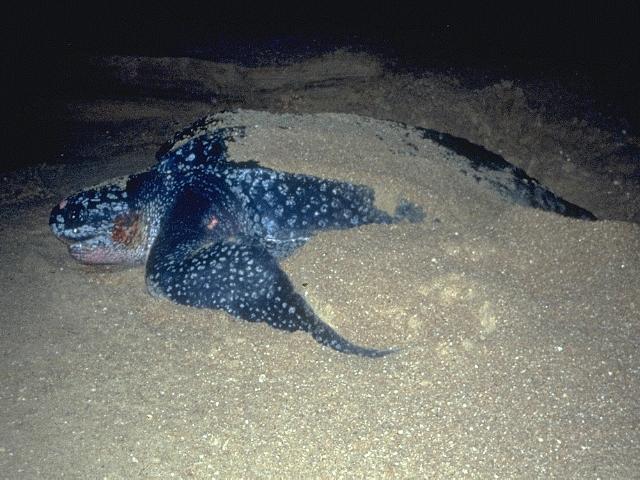
This is a leatherback nesting in Suriname. The picture was provided by the team of Matthew Godfrey of the University of Toronto and Ruth Baretto of York University. We wish to say mahalo nui loa to Ruth and Matthew for permission to use this beautiful photo.
60K JPEG
The following is based on information from the Recovery Plan for U.S. Population of Leatherback Turtles, U.S Fish and Wildlife Service and National Marine Fisheries Service, 1992. Obtained from the U.S. National Marine Fisheries Service, and used with their kind permission.
Current Status
The U.S. Federal government has listed the leatherback as endangered worldwide.
Within the U.S., the leatherback is known to nest in Southeastern Florida, Culebra, Puerto Rico, and St. Croix.
Description
The leatherback is the largest living turtle and is so distinctive that it is placed in its own separate family, Dermochelys.
All other sea turtles have bony hard plates on their shells (carapace). The leatherback's carapace is slightly flexible and has a rubbery texture. No sharp angle is formed between the carapace and the under-belly (plastron) so a leatherback is somewhat barrel-shaped. Many can grow to be bigger than one too.
The front flippers of a leatherback are longer than in the other marine turtles, even when you take the leatherback's size into account. They can reach 270 cm in adult leatherbacks.
The largest leatherback on record was a male stranded on the West Coast of Wales in 1988. He weighed 916 kg.
Leatherback hatchlings look mostly black when you are glancing down on them, and their flippers are margined in white. Rows of white scales give hatchling leatherbacks the white striping that runs down the length of their backs.
While the Recovery Plan (being a scientific document) makes no mention of this, Turtle Trax would be remiss not to mention it here: hatchling leatherbacks are cute and engaging little animals.
Of considerable interest is that the core body temperature of adults in cold water has been shown to be several degrees Centigrade above the surrounding water. This allows leatherbacks to prosper in ocean regions where other marine reptiles cannot. Fellow Canadian Michael James of Dalhousie University has been training fishermen in eastern Canada to spot leatherbacks, resulting in numerous sightings and an increased awareness that sea turtles inhabit Canadian waters too.
In 1982, Peter Pritchard estimated that 115,000 adult female leatherbacks existed worldwide and that roughly half of them probably were nesting in western Mexico. In recent years, however, the number of nesting leatherbacks has been in an alarming decline.
Threats
Leatherbacks have historically been taken only rarely for their meat. The greatest threat used to be to their eggs, and this threat still exists. There aren't as many eggs to poach these days, however, because fewer and fewer leatherbacks show up to nest. Scientists have concluded that gill-net and longline fisheries are to blame,
Commercial Fisheries
In 1987, it was estimated that offshore shrimp fleets capture about 640 leatherbacks each year. About a quarter (160) die from drowning and many others die when they are injured unintentionally on the decks of these trawlers. A few years ago, US regulations made the use of Turtle Excluder Devices (TEDs) mandatory. While compliance remains a problem, TEDs have saved many leatherbacks.
A group of sea turtle biologists recently concluded (June, 2000) that gill-net and longline fisheries were probably causing the decline. They published their findings in the prestigious journal Nature. They based their findings on the steep decline in the number of nesting turtles. Although some actions have been taken to limit the impact of longline fishing in the Pacific, the future of the leatherback is still seriously in doubt.
Nesting Environment
Leatherbacks prefer open access beaches possibly to avoid damage to their soft plastron and flippers. Unfortunately, such open beaches with little shoreline protection are vulnerable to beach erosion triggered by seasonal changes in wind and wave direction. A presumably secure beach can undergo such severe and dramatic erosion that eggs laid on it are lost.
The theft of eggs for local consumption is not currently a problem in Florida but continues in low levels in the U.S. Virgin Islands. Even though the harvest of turtle eggs is illegal in Puerto Rico, law enforcement efforts have been unsuccessful in deterring it. Historically, the situation was no better on Puerto Rico's smaller islands: e.g. egg poaching has been described as "extensive and unrelenting" (Carr 1978) and a "major problem" (Tucker 1988) on Culebra. Today poaching has been all but eliminated on Culebra as a result of nightly partrol and nest protection programs initiated by FWS on important nesting beaches in 1984.
Leatherbacks are also vulnerable to beach armouring, beach nourishment, artificial lighting, and human encroachment, as described in Threats to Marine Turtles.
Entanglement at Sea
Leatherbacks are the most pelagic of turtles, feeding in the open ocean rather than near shore as other marine turtles do. At sea, they become entangled fairly often in longlines, buoy anchor lines and other ropes and cables. This can result in injury (rope or cable cuts on shoulders and flippers) or drowning.
Ingestion of Marine Debris
Leatherbacks have mistaken plastic bags, raw plastic pellets, plastic and styrofoam, tar balls and balloons for their natural food. Ingesting this debris can obstruct the gut, lead to absorption of toxins and reduce the absorption of nutrients from their real food.
Leatherbacks appear to mistake floating plastic in the form of bags or sheets for jellyfish and then eat it. Ten of 33 dead leatherbacks washed ashore between 1979 and 1988 had ingested plastic bags, plastic sheets or monofilament.
Conservation Accomplishment
The Recovery Plan for the U.S. Population of Leatherback Turtles states:
A substantial effort is being made by government and non-government agencies and private individuals to increase public awareness of sea turtle conservation issues. Federal and State agencies and private conservation organizations such as the Centre for Marine Conservation, Greenpeace and National Audobon Society, have produced and distributed a variety of audio-visual aids and printed material about sea turtles. These include: a booklet on the various types of light fixtures and ways of screening lights to lessen their effects on hatchlings (Raymond 1984), the brochures "Attention Beach Users, "Lights Out" bumper stickers and decals, a coloring book, video tapes, slide/tape programs, full color identification posters of the eight species of sea turtles, and a hawksbill poster. Florida Power and Light Company also has produced a booklet (Van Meter, 1990) with general information on sea turtles. In the USVI, the St. Croix Environmental Association, the University of Virgin Islands Extension Service, the Environmental Association, the University of the Virgin Islands Extension Service, the VIDFW and NPS are actively involved in circulating newsletters and information packages, and in presenting slide shows and seminars. EARTHWATCH-supported projects in Puerto Rico and in the USVI have involved many people in sea turtle conservation efforts. These projects on Sandy Point, NWR, St. Croix, and Culebra, Puerto Rico, have both brought a great deal of attention to this species and have generated high levels of local involvement and awareness. In both locations, the general public has become aware of the problems facing the species and in general has developed protectionist attitudes, in contrast to previous attitudes of exploitation.
Leatherback Quick Facts
Reprinted from Florida's Sea Turtles, Copyright 1992, courtesy the Florida Power & Light Company.
The leatherback is the largest of the sea turtles; it travels the farthest, dives the deepest and ventures into the coldest water.
Named for smooth, rubbery shell
Feeds on jellyfish
About 50 nests a year reported in Florida, estimates of 70,000 to 115,000 breeding females worldwide
A huge turtle: adults weigh 700 to 2,000 pounds and measure 4 to 8 feet in length
Hatchlings: 2-1/2 inches long
Nest in Florida from April through July
Many leatherback turtles die from ingesting plastic debris mistaken for jellyfish
This is a leatherback nesting in Suriname. The picture was provided by the team of Matthew Godfrey of the University of Toronto and Ruth Baretto of York University. We wish to say mahalo nui loa to Ruth and Matthew for permission to use this beautiful photo.
60K JPEG
The following is based on information from the Recovery Plan for U.S. Population of Leatherback Turtles, U.S Fish and Wildlife Service and National Marine Fisheries Service, 1992. Obtained from the U.S. National Marine Fisheries Service, and used with their kind permission.
Current Status
The U.S. Federal government has listed the leatherback as endangered worldwide.
Within the U.S., the leatherback is known to nest in Southeastern Florida, Culebra, Puerto Rico, and St. Croix.
Description
The leatherback is the largest living turtle and is so distinctive that it is placed in its own separate family, Dermochelys.
All other sea turtles have bony hard plates on their shells (carapace). The leatherback's carapace is slightly flexible and has a rubbery texture. No sharp angle is formed between the carapace and the under-belly (plastron) so a leatherback is somewhat barrel-shaped. Many can grow to be bigger than one too.
The front flippers of a leatherback are longer than in the other marine turtles, even when you take the leatherback's size into account. They can reach 270 cm in adult leatherbacks.
The largest leatherback on record was a male stranded on the West Coast of Wales in 1988. He weighed 916 kg.
Leatherback hatchlings look mostly black when you are glancing down on them, and their flippers are margined in white. Rows of white scales give hatchling leatherbacks the white striping that runs down the length of their backs.
While the Recovery Plan (being a scientific document) makes no mention of this, Turtle Trax would be remiss not to mention it here: hatchling leatherbacks are cute and engaging little animals.
Of considerable interest is that the core body temperature of adults in cold water has been shown to be several degrees Centigrade above the surrounding water. This allows leatherbacks to prosper in ocean regions where other marine reptiles cannot. Fellow Canadian Michael James of Dalhousie University has been training fishermen in eastern Canada to spot leatherbacks, resulting in numerous sightings and an increased awareness that sea turtles inhabit Canadian waters too.
In 1982, Peter Pritchard estimated that 115,000 adult female leatherbacks existed worldwide and that roughly half of them probably were nesting in western Mexico. In recent years, however, the number of nesting leatherbacks has been in an alarming decline.
Threats
Leatherbacks have historically been taken only rarely for their meat. The greatest threat used to be to their eggs, and this threat still exists. There aren't as many eggs to poach these days, however, because fewer and fewer leatherbacks show up to nest. Scientists have concluded that gill-net and longline fisheries are to blame,
Commercial Fisheries
In 1987, it was estimated that offshore shrimp fleets capture about 640 leatherbacks each year. About a quarter (160) die from drowning and many others die when they are injured unintentionally on the decks of these trawlers. A few years ago, US regulations made the use of Turtle Excluder Devices (TEDs) mandatory. While compliance remains a problem, TEDs have saved many leatherbacks.
A group of sea turtle biologists recently concluded (June, 2000) that gill-net and longline fisheries were probably causing the decline. They published their findings in the prestigious journal Nature. They based their findings on the steep decline in the number of nesting turtles. Although some actions have been taken to limit the impact of longline fishing in the Pacific, the future of the leatherback is still seriously in doubt.
Nesting Environment
Leatherbacks prefer open access beaches possibly to avoid damage to their soft plastron and flippers. Unfortunately, such open beaches with little shoreline protection are vulnerable to beach erosion triggered by seasonal changes in wind and wave direction. A presumably secure beach can undergo such severe and dramatic erosion that eggs laid on it are lost.
The theft of eggs for local consumption is not currently a problem in Florida but continues in low levels in the U.S. Virgin Islands. Even though the harvest of turtle eggs is illegal in Puerto Rico, law enforcement efforts have been unsuccessful in deterring it. Historically, the situation was no better on Puerto Rico's smaller islands: e.g. egg poaching has been described as "extensive and unrelenting" (Carr 1978) and a "major problem" (Tucker 1988) on Culebra. Today poaching has been all but eliminated on Culebra as a result of nightly partrol and nest protection programs initiated by FWS on important nesting beaches in 1984.
Leatherbacks are also vulnerable to beach armouring, beach nourishment, artificial lighting, and human encroachment, as described in Threats to Marine Turtles.
Entanglement at Sea
Leatherbacks are the most pelagic of turtles, feeding in the open ocean rather than near shore as other marine turtles do. At sea, they become entangled fairly often in longlines, buoy anchor lines and other ropes and cables. This can result in injury (rope or cable cuts on shoulders and flippers) or drowning.
Ingestion of Marine Debris
Leatherbacks have mistaken plastic bags, raw plastic pellets, plastic and styrofoam, tar balls and balloons for their natural food. Ingesting this debris can obstruct the gut, lead to absorption of toxins and reduce the absorption of nutrients from their real food.
Leatherbacks appear to mistake floating plastic in the form of bags or sheets for jellyfish and then eat it. Ten of 33 dead leatherbacks washed ashore between 1979 and 1988 had ingested plastic bags, plastic sheets or monofilament.
Conservation Accomplishment
The Recovery Plan for the U.S. Population of Leatherback Turtles states:
A substantial effort is being made by government and non-government agencies and private individuals to increase public awareness of sea turtle conservation issues. Federal and State agencies and private conservation organizations such as the Centre for Marine Conservation, Greenpeace and National Audobon Society, have produced and distributed a variety of audio-visual aids and printed material about sea turtles. These include: a booklet on the various types of light fixtures and ways of screening lights to lessen their effects on hatchlings (Raymond 1984), the brochures "Attention Beach Users, "Lights Out" bumper stickers and decals, a coloring book, video tapes, slide/tape programs, full color identification posters of the eight species of sea turtles, and a hawksbill poster. Florida Power and Light Company also has produced a booklet (Van Meter, 1990) with general information on sea turtles. In the USVI, the St. Croix Environmental Association, the University of Virgin Islands Extension Service, the Environmental Association, the University of the Virgin Islands Extension Service, the VIDFW and NPS are actively involved in circulating newsletters and information packages, and in presenting slide shows and seminars. EARTHWATCH-supported projects in Puerto Rico and in the USVI have involved many people in sea turtle conservation efforts. These projects on Sandy Point, NWR, St. Croix, and Culebra, Puerto Rico, have both brought a great deal of attention to this species and have generated high levels of local involvement and awareness. In both locations, the general public has become aware of the problems facing the species and in general has developed protectionist attitudes, in contrast to previous attitudes of exploitation.
Leatherback Quick Facts
Reprinted from Florida's Sea Turtles, Copyright 1992, courtesy the Florida Power & Light Company.
The leatherback is the largest of the sea turtles; it travels the farthest, dives the deepest and ventures into the coldest water.
Named for smooth, rubbery shell
Feeds on jellyfish
About 50 nests a year reported in Florida, estimates of 70,000 to 115,000 breeding females worldwide
A huge turtle: adults weigh 700 to 2,000 pounds and measure 4 to 8 feet in length
Hatchlings: 2-1/2 inches long
Nest in Florida from April through July
Many leatherback turtles die from ingesting plastic debris mistaken for jellyfish
Tuesday, February 12, 2008
Horseshoe Crabs #2
The horseshoe crab, horsefoot, king crab, or sauce-pan (Limulus polyphemus, formerly known as Limulus cyclops, Xiphosura americana, Polyphemus occidentalis) is a chelicerate arthropod. Therefore, it is more closely related to spiders, ticks, and scorpions than to true crabs. Horseshoe crabs are most commonly found in the Gulf of Mexico and along the northern Atlantic coast of North America. A main area of annual migration is the Delaware Bay, although stray individuals are occasionally found in Europe.[3]
Three other species from the same family in the Indian and Pacific Oceans are also called horseshoe crabs.[4] The Japanese horseshoe crab (Tachypleus gigas) is found in the Seto Inland Sea, and is considered an endangered species because of loss of habitat. Two other species occur along the east coast of India: Tachypleus tridentatus and Carcinoscorpius rotundicauda.[5] A research project to protect them is on in Chandipur.
Horseshoe crabs have kept the same body plan for almost half a billion years. The diminutive horseshoe crab, Lunataspis aurora, just 4 centimeters (1.5 inches) from head to tail-tip, have been identified in 445-million-year-old Ordovician strata in Manitoba.[6]
Contents[hide]
[edit] Physical description
Underside of a female showing the legs and book gills.
Horseshoe crabs possess five pairs of book gills located just behind their appendages that allow them to breathe underwater, and can also allow them to breathe on land for short periods of time, provided the gills remain moist. The outer shell of these animals consists of three parts. The carapace is the smooth frontmost part of the crab which contains the eyes, the walking legs, the chelicera (pincers), the mouth, the brain, and the heart. The abdomen is the middle portion where the gills are attached as well as the genital operculum. The last section is the "telson" (i.e., "tail" or "caudal spine") which is used to flip itself over if stuck upside down.
They can grow up to 24 inches (60 cm), on a diet of molluscs, annelid worms, and other benthic invertebrates. Its mouth is located in the middle of the underside of the cephalothorax. A pair of pincers (chelicerae) for seizing food are found on each side of the mouth.
Limulus has been extensively used in research into the physiology of vision. It has four compound eyes, and each ommatidium feeds into a single nerve fibre. Furthermore the nerves are large and relatively accessible. This made it possible for electrophysiologists to record the nervous response to light stimulation easily, and to observe visual phenomena like lateral inhibition working at the cellular level. More recently, behavioral experiments have investigated the functions of visual perception in Limulus. Habituation and classical conditioning to light stimuli have been demonstrated, as has the use of brightness and shape information by male Limuli when recognizing potential mates. It has also been said that it is able to see ultra-violet light.
Among other senses, they have a small sense organ on the triangular area formed by the exoskeleton beneath the body near the ventral eyes.
The mouth opening is between the legs, the gills are visible below
Horseshoe crabs can live for 24-31 years. They migrate into the shore in late spring, with the males arriving first. The females then arrive and make nests at a depth of 15-20 cm in the sand. In the nests, females deposit eggs which are subsequently fertilized by the male. Egg quantity is dependent on female body size and ranges from 15,000-64,000 eggs per female."Development begins when the first egg cover splits and new membrane, secreted by the embryo, forms a transparent spherical capsule" (Sturtevant). The larvae form and then swim for about five to seven days. After swimming they settle, and begin the first molt. This occurs approximately twenty days after the formation of the egg capsule. As young horseshoe crabs grow, they move to deeper waters, where molting continues. They reach sexual maturity in approximately eleven years and may live another 10-14 years beyond that.
Although most arthropods have mandibles, the horseshoe crab is jawless. The horseshoe crab's mouth is located in the center of the body. In the female, the four large legs are all alike, and end in pincers. In the male, the first of the four large legs is modified, with a bulbuous claw that serves to lock the male to the female while she deposits the eggs and he waits to fertilize them.
Horseshoe crabs are distant relatives of spiders and are probably descended from the ancient eurypterids (sea scorpions). They evolved in the shallow seas of the Paleozoic Era (540-248 million years ago) with other primitive arthropods like the trilobites. Horseshoe crabs are one of the oldest classes of marine arthropods, and are often referred to as "living fossils", as they have changed little in the last 350 to 400 million years.
Underside of a male, showing the first leg modified for grasping the female during copulation
[edit] Regeneration
Horseshoe crabs possess the rare ability to regrow lost limbs, in a manner similar to sea stars.[8]
[edit] Medical research
Horseshoe crabs are valuable as a species to the medical research community. The horseshoe crab has a simple but effective immune system. When a foreign object such as bacteria enters through a wound in the animal's body, it almost immediately clots into a clear gel-like material, thus effectively trapping the bacteria. This substance is called Limulus Amebocyte Lysate (LAL) and is being used to test for bacterial endotoxins in pharmaceuticals and for several bacterial diseases. If the bacterium is harmful, the blood will form a clot. Horseshoe crabs are helpful in finding remedies for diseases that have developed resistances to penicillin and other drugs. Since a horseshoe crab is returned to water after extraction of a portion of its blood, tests are not a threat to the survival of horseshoe crabs. A single horseshoe crab can be worth $2,500 over its lifetime for periodic blood extractions.
[edit] Hemocyanin
The blood of most molluscs, including cephalopods and gastropods, as well as some arthropods such as horseshoe crabs contains the copper containing protein hemocyanin at concentrations of about 50 gms per litre. Hemocyanin is colourless when deoxygenated and dark blue when oxygenated. The blood in the circulation of these creatures, which generally live in cold environments with low oxygen tensions, is grey-white to pale yellow, and it turns dark blue when exposed to the oxygen in the air, as seen when they bleed. This is due to change in color of hemocyanin when is it oxidized. Hemocyanin carries oxygen in extracellular fluid, which is in contrast to the intracellular oxygen transport in mammals by hemoglobin in red blood cells.
[edit] Conservation
Limulus polyphemus is not presently endangered, but harvesting and habitat destruction have reduced its numbers at some locations and caused some concern for this animal's future. Since the 1970s, the horseshoe crab population has been decreasing in some areas, due to several factors, including the use of the crab as bait in whelk and conch trapping.
In 1995, the nonprofit Ecological Research and Development Group (ERDG) was founded with the aim of preserving the four remaining species of horseshoe crab. Since its inception, the ERDG has made significant contributions to horseshoe crab conservation. ERDG founder Glenn Gauvry designed a mesh bag for whelk/conch traps, to prevent other species from removing the bait. This has led to a decrease in the amount of bait needed by approximately 50%. In the state of Virginia, these mesh bags are mandatory in whelk/conch fishery. The Atlantic States Marine Fisheries Commission is in 2006 considering several conservation options, among them being a two-year ban on harvesting the animals affecting both Delaware and New Jersey shores of Delaware Bay.[10] In June of 2007, Delaware Superior Court Judge Richard Stokes has allowed limited harvesting of 100,000 males. He ruled that while the crab population was seriously depleted by over-harvesting through 1998, it has since stabilized and that this limited take of males will not adversely affect either Horseshoe Crab or Red Knot populations. In opposition, Delaware environmental secretary John Hughes concluded that a decline in the Red Knot bird population was so significant that extreme measures were needed to ensure a supply of crab eggs when the birds arrived.Every year approximately 10% of the horseshoe crab breeding population dies when rough surf flips the creatures onto their backs, a position from which they often cannot right themselves. In response, the ERDG (Ecological Resource and Development Group) launched a "Just Flip 'Em" campaign, in the hopes that beachgoers will simply turn the crabs back over.
Conservationists have also voiced concerns about the declining population of shorebirds, such as Red Knots, which rely heavily on the horseshoe crabs' eggs for food during their Spring migration. Precipitous declines in the population of the Red Knots have been observed in recent years. Predators of horseshoe crabs, such as the currently threatened Atlantic Loggerhead Turtle, have also suffered as crab populations diminish.
Three other species from the same family in the Indian and Pacific Oceans are also called horseshoe crabs.[4] The Japanese horseshoe crab (Tachypleus gigas) is found in the Seto Inland Sea, and is considered an endangered species because of loss of habitat. Two other species occur along the east coast of India: Tachypleus tridentatus and Carcinoscorpius rotundicauda.[5] A research project to protect them is on in Chandipur.
Horseshoe crabs have kept the same body plan for almost half a billion years. The diminutive horseshoe crab, Lunataspis aurora, just 4 centimeters (1.5 inches) from head to tail-tip, have been identified in 445-million-year-old Ordovician strata in Manitoba.[6]
Contents[hide]
[edit] Physical description
Underside of a female showing the legs and book gills.
Horseshoe crabs possess five pairs of book gills located just behind their appendages that allow them to breathe underwater, and can also allow them to breathe on land for short periods of time, provided the gills remain moist. The outer shell of these animals consists of three parts. The carapace is the smooth frontmost part of the crab which contains the eyes, the walking legs, the chelicera (pincers), the mouth, the brain, and the heart. The abdomen is the middle portion where the gills are attached as well as the genital operculum. The last section is the "telson" (i.e., "tail" or "caudal spine") which is used to flip itself over if stuck upside down.
They can grow up to 24 inches (60 cm), on a diet of molluscs, annelid worms, and other benthic invertebrates. Its mouth is located in the middle of the underside of the cephalothorax. A pair of pincers (chelicerae) for seizing food are found on each side of the mouth.
Limulus has been extensively used in research into the physiology of vision. It has four compound eyes, and each ommatidium feeds into a single nerve fibre. Furthermore the nerves are large and relatively accessible. This made it possible for electrophysiologists to record the nervous response to light stimulation easily, and to observe visual phenomena like lateral inhibition working at the cellular level. More recently, behavioral experiments have investigated the functions of visual perception in Limulus. Habituation and classical conditioning to light stimuli have been demonstrated, as has the use of brightness and shape information by male Limuli when recognizing potential mates. It has also been said that it is able to see ultra-violet light.
Among other senses, they have a small sense organ on the triangular area formed by the exoskeleton beneath the body near the ventral eyes.
The mouth opening is between the legs, the gills are visible below
Horseshoe crabs can live for 24-31 years. They migrate into the shore in late spring, with the males arriving first. The females then arrive and make nests at a depth of 15-20 cm in the sand. In the nests, females deposit eggs which are subsequently fertilized by the male. Egg quantity is dependent on female body size and ranges from 15,000-64,000 eggs per female."Development begins when the first egg cover splits and new membrane, secreted by the embryo, forms a transparent spherical capsule" (Sturtevant). The larvae form and then swim for about five to seven days. After swimming they settle, and begin the first molt. This occurs approximately twenty days after the formation of the egg capsule. As young horseshoe crabs grow, they move to deeper waters, where molting continues. They reach sexual maturity in approximately eleven years and may live another 10-14 years beyond that.
Although most arthropods have mandibles, the horseshoe crab is jawless. The horseshoe crab's mouth is located in the center of the body. In the female, the four large legs are all alike, and end in pincers. In the male, the first of the four large legs is modified, with a bulbuous claw that serves to lock the male to the female while she deposits the eggs and he waits to fertilize them.
Horseshoe crabs are distant relatives of spiders and are probably descended from the ancient eurypterids (sea scorpions). They evolved in the shallow seas of the Paleozoic Era (540-248 million years ago) with other primitive arthropods like the trilobites. Horseshoe crabs are one of the oldest classes of marine arthropods, and are often referred to as "living fossils", as they have changed little in the last 350 to 400 million years.
Underside of a male, showing the first leg modified for grasping the female during copulation
[edit] Regeneration
Horseshoe crabs possess the rare ability to regrow lost limbs, in a manner similar to sea stars.[8]
[edit] Medical research
Horseshoe crabs are valuable as a species to the medical research community. The horseshoe crab has a simple but effective immune system. When a foreign object such as bacteria enters through a wound in the animal's body, it almost immediately clots into a clear gel-like material, thus effectively trapping the bacteria. This substance is called Limulus Amebocyte Lysate (LAL) and is being used to test for bacterial endotoxins in pharmaceuticals and for several bacterial diseases. If the bacterium is harmful, the blood will form a clot. Horseshoe crabs are helpful in finding remedies for diseases that have developed resistances to penicillin and other drugs. Since a horseshoe crab is returned to water after extraction of a portion of its blood, tests are not a threat to the survival of horseshoe crabs. A single horseshoe crab can be worth $2,500 over its lifetime for periodic blood extractions.
[edit] Hemocyanin
The blood of most molluscs, including cephalopods and gastropods, as well as some arthropods such as horseshoe crabs contains the copper containing protein hemocyanin at concentrations of about 50 gms per litre. Hemocyanin is colourless when deoxygenated and dark blue when oxygenated. The blood in the circulation of these creatures, which generally live in cold environments with low oxygen tensions, is grey-white to pale yellow, and it turns dark blue when exposed to the oxygen in the air, as seen when they bleed. This is due to change in color of hemocyanin when is it oxidized. Hemocyanin carries oxygen in extracellular fluid, which is in contrast to the intracellular oxygen transport in mammals by hemoglobin in red blood cells.
[edit] Conservation
Limulus polyphemus is not presently endangered, but harvesting and habitat destruction have reduced its numbers at some locations and caused some concern for this animal's future. Since the 1970s, the horseshoe crab population has been decreasing in some areas, due to several factors, including the use of the crab as bait in whelk and conch trapping.
In 1995, the nonprofit Ecological Research and Development Group (ERDG) was founded with the aim of preserving the four remaining species of horseshoe crab. Since its inception, the ERDG has made significant contributions to horseshoe crab conservation. ERDG founder Glenn Gauvry designed a mesh bag for whelk/conch traps, to prevent other species from removing the bait. This has led to a decrease in the amount of bait needed by approximately 50%. In the state of Virginia, these mesh bags are mandatory in whelk/conch fishery. The Atlantic States Marine Fisheries Commission is in 2006 considering several conservation options, among them being a two-year ban on harvesting the animals affecting both Delaware and New Jersey shores of Delaware Bay.[10] In June of 2007, Delaware Superior Court Judge Richard Stokes has allowed limited harvesting of 100,000 males. He ruled that while the crab population was seriously depleted by over-harvesting through 1998, it has since stabilized and that this limited take of males will not adversely affect either Horseshoe Crab or Red Knot populations. In opposition, Delaware environmental secretary John Hughes concluded that a decline in the Red Knot bird population was so significant that extreme measures were needed to ensure a supply of crab eggs when the birds arrived.Every year approximately 10% of the horseshoe crab breeding population dies when rough surf flips the creatures onto their backs, a position from which they often cannot right themselves. In response, the ERDG (Ecological Resource and Development Group) launched a "Just Flip 'Em" campaign, in the hopes that beachgoers will simply turn the crabs back over.
Conservationists have also voiced concerns about the declining population of shorebirds, such as Red Knots, which rely heavily on the horseshoe crabs' eggs for food during their Spring migration. Precipitous declines in the population of the Red Knots have been observed in recent years. Predators of horseshoe crabs, such as the currently threatened Atlantic Loggerhead Turtle, have also suffered as crab populations diminish.
Horseshoe Crabs #1
The hosrseshoe crab is called a "living fossil" because it has been on earth for millions of years. Although called a crab, it is not a crustacean, but belongs to the arachnid or spider family.
The male horseshoe crab is smaller than the female horseshoe crab. The body is sometimes two feet long. Alive, it is a brownish-green color. After it dies, the adult is dark brown. They breathe by means of gills attached to the underside of the last pair of abdominal legs. The mouth is on the underside of the center of the body. The eyes are on the top of the front part of the shell.
If horseshoe crabs get turned on their back in the surf and get stranded on the beach, they use their long tail to turn over. If they cannot get turned back over they die.
Horseshoe crabs spawn in only two places in the United States. They spawn on the shores of the Delaware Bay, which is between the states of Delaware and New Jersey. The other place is Long Island, New York. [See message from Briana Brown at the bottom of this webpage. She adds much of the New England coast to the list of spawning grounds.] Sometimes their shells are found on other beaches. Most of the time they have died and have just washed up on those beaches. Their spawning time is the last two weeks in May and the first two weeks in June. They crowd up on the beach at high tide. The female scoops out a hole in the sand with the front part of her body and lays thousands of eggs and the male fertilizes them. After they spawn, they go back to the deep water.
The eggs look like a very small green sphere. The embryp looks like the adult, but it has its tail folded beside it. Birds fly up from South America, going north to nest. They stop by the Delaware Bay to feast on the horseshoe crab eggs. They eat enough to triple their weight before they continue their journey.
The male horseshoe crab is smaller than the female horseshoe crab. The body is sometimes two feet long. Alive, it is a brownish-green color. After it dies, the adult is dark brown. They breathe by means of gills attached to the underside of the last pair of abdominal legs. The mouth is on the underside of the center of the body. The eyes are on the top of the front part of the shell.
If horseshoe crabs get turned on their back in the surf and get stranded on the beach, they use their long tail to turn over. If they cannot get turned back over they die.
Horseshoe crabs spawn in only two places in the United States. They spawn on the shores of the Delaware Bay, which is between the states of Delaware and New Jersey. The other place is Long Island, New York. [See message from Briana Brown at the bottom of this webpage. She adds much of the New England coast to the list of spawning grounds.] Sometimes their shells are found on other beaches. Most of the time they have died and have just washed up on those beaches. Their spawning time is the last two weeks in May and the first two weeks in June. They crowd up on the beach at high tide. The female scoops out a hole in the sand with the front part of her body and lays thousands of eggs and the male fertilizes them. After they spawn, they go back to the deep water.
The eggs look like a very small green sphere. The embryp looks like the adult, but it has its tail folded beside it. Birds fly up from South America, going north to nest. They stop by the Delaware Bay to feast on the horseshoe crab eggs. They eat enough to triple their weight before they continue their journey.
Lobsters #2
Clawed lobsters compose a family (Nephropidae, sometimes also Homaridae) of large marine crustaceans. Lobsters are economically important as seafood, forming the basis of a global industry that nets US$1.8 billion in trade annually.
Though several different groups of crustaceans are known as "lobsters," the clawed lobsters are most often associated with the name. Clawed lobsters are not closely related with spiny lobsters or slipper lobsters, which have no claws (chelae), or squat lobsters. The closest relatives of clawed lobsters are the reef lobster Enoplometopus and the three families of freshwater crayfish.
Contents[hide]
[edit] Biology
Lobsters are invertebrates and have a hard protective exoskeleton. Like most arthropods, lobsters must molt in order to grow, leaving them vulnerable during this time. During the molting process, several species may experience a change in color.
Lobsters live on rocky, sandy, or muddy bottoms from the shoreline to beyond the edge of the continental shelf. They generally live singly in crevices or in burrows under rocks.
Lobsters typically eat live food, consisting of fish, molluscs, other crustaceans, worms, and some plant life. Occasionally, they will scavenge if necessary, and may resort to cannibalism in captivity; however, this has not been observed in the wild. Lobster skin in the stomachs of lobsters has been found before, although this is because lobsters will eat their shed skin after molting.[1] Lobsters grow throughout their lives and it is not unusual for a lobster to live for more than 100 years.[2] They can thus reach impressive sizes. According to the Guinness World Records, the largest lobster was caught in Nova Scotia, Canada, and weighed 20.14 kg (44.4 lb).
Being arthropods, lobsters are largely bilaterally symmetrical; clawed lobsters often possess unequal, specialized claws, like the king crab. A freshly caught lobster will have a claw that is full and fleshy, not atrophied. The anatomy of the lobster includes the cephalothorax which is the head fused with the thorax, both of which are covered by the carapace, of chitinous composition, and the abdomen. The lobster's head consists of antennae, antennules, mandibles, the first and second maxillae, and the first, second, and third maxillipeds. Because a lobster lives in a murky environment at the bottom of the ocean, its vision is poor and it mostly uses its antennae as sensors. Studies have shown that the lobster eye is formed with a reflective structure atop a convex retina. In contrast, most complex eyes use refractive ray concentrators (lenses) and a concave retina.[3] The abdomen of the lobster includes swimmerets and its tail is composed of uropods and the telson.
In general, lobsters move slowly by walking on the bottom of the sea floor. However, when they are in danger and need to flee, they swim backwards quickly by curling and uncurling their abdomen. A speed of 5 meters per second has been recorded.[4]
Lobsters come in a variety of colors inculding, but not limited to, red, blue, green, purple, yellow, and magenta.
[edit] Symbion
The genus Symbion, the only member of the animal phylum Cycliophora, has only been found on the gills and mouthparts of lobsters.[5]
[edit] List of clawed lobster species
This list contains all known species in the family Nephropidae:[6]
Acanthacaris caeca
Acanthacaris tenuimana
Eunephrops bairdii
Eunephrops cadenasi
Eunephrops luckhursti
Eunephrops manningi
Homarinus capensis — Cape lobster
Homarus americanus — American lobster
Homarus gammarus — European lobster
Metanephrops andamanicus — Andaman lobster
Metanephrops arafurensis
Metanephrops armatus
Metanephrops australiensis — Australian scampi
Metanephrops binghami — Caribbean lobster
Metanephrops boschmai — bight lobster
Metanephrops challengeri — New Zealand scampi
Metanephrops formosanus
Metanephrops japonicus — Japanese lobster
Metanephrops mozambicus
Metanephrops neptunus
Metanephrops rubellus
Metanephrops sagamiensis
Metanephrops sibogae
Metanephrops sinensis
Metanephrops thomsoni
Metanephrops velutinus
Nephropides caribaeus
Nephrops norvegicus — Norway lobster
Nephropsis acanthura
Nephropsis aculeata — Florida lobsterette
Nephropsis agassizii
Nephropsis atlantica
Nephropsis carpenteri
Nephropsis ensirostris
Nephropsis hamadai
Nephropsis holthuisii
Nephrops macphersoni
Nephropsis malhaensis
Nephropsis neglecta
Nephropsis occidentalis
Nephropsis rosea
Nephropsis serrata
Nephropsis stewarti
Nephropsis suhmi
Nephropsis sulcata
Thymopides grobovi
Thymops birsteini
Thymopsis nilenta
[edit] Gastronomy
A 3 kg european lobster
Lobster is a valued foodstuff; well-known recipes include Lobster Newburg and Lobster Thermidor. Lobster is best eaten fresh, and they are normally purchased live. Lobsters are usually shipped and sold with their claws banded to prevent them from injuring each other or the purchaser. Lobsters cannot open and close the claws when they are banded, which causes the claws to begin to atrophy inside the shell. Very fresh lobsters will not show this, and the claws will be full. Many restaurants that serve lobster keep a tank of the live creatures, often allowing patrons to pick their own.
Lobsters are generally prepared and cooked while they are still alive, thus a lobster can have both its claws cut off and its body will still be moving. If the lobster is to be boiled or steamed, most cooks place the live lobster into the pot; this will kill off the lobster. If the lobster is to be fried, grilled or baked it is best not to boil the lobster before further cooking. Freezing the lobster may toughen the meat.
When boiling a lobster, the general rule of thumb is to simmer the lobster for 7 minutes for the first pound and 3 minutes for each additional pound.[7]
A dish including an European lobster, Dubrovnik
The shell of the lobster makes eating them a slow process for the unskilled or timid, who may require a number of implements including nutcrackers, a small fork, and a plastic bib. It is possible to shell a lobster by hand if one is careful to avoid the sharp points. The tail can be snapped open by first squeezing its sides inward, and then grabbing the edges of the shell, placing the thumbs on the dorsal side and pulling the sides apart. The claws usually open by hyper-extending the lobster's "thumb" and then pulling it out. Sometimes the claws can then be cracked by simply squeezing them. Otherwise, an ordinary fork is usually sufficient to snap open the side of the claw. Some restaurants will split the tail of the lobster and crack the claws in the kitchen. This is done to simplify their diner's meals and in some cases as a decorative step. (Especially when the lobster is to be served with a sauce poured over the tail.)
The majority of the meat is in the tail and the two front claws, but smaller quantities can be found in the legs and torso. The larger the lobster the greater the proportion of meat in the small legs and body. Lobster can be consumed simply, boiled or steamed, or used in a wide array of dishes and salads. It can be served as lobster soup or bisque or mixed with mayonnaise or salad dressing for lobster rolls. Lobster meat is often dipped in melted butter, resulting in a sweetened flavor.
[edit] History
The European wild lobster, among whom is the royal blue lobster of Audresselles, is more expensive and rare than the American lobster but was always appreciated chiefly among the royal and aristocratic families of France and the Netherlands. Such scenes were depicted in Dutch paintings of the sixteenth and seventeenth centuries.
In North America prior to the 20th century, local lobster was not a popular food. In the Maritimes, eating lobster was considered a mark of poverty. In some parts of the Maritime provinces of Canada, lobster was used as a fertilizer for farmers' fields, and a great deal of lobster was fed to slaves or the lower members of society. Outside of the rural outports lobster was sold canned, losing much of its flavour, which can be disguised if the lobster is dipped in drawn butter.
The reputation of lobster changed with the development of the modern transportation industry that allowed live lobsters to be shipped from the ports to large urban centres. Fresh lobster quickly became a luxury food and a tourist attraction for the Maritime provinces and Maine and an export to Europe and Japan where it is especially expensive.
The expense of eating lobster has led to supermarkets selling "faux lobster"; (which is clearly labeled as such), and it is made from fish (often pollock or other whitefish) that has been altered to look and taste similar to lobster. A few restaurants have gone so far as to sell "langostino lobster". Langostino translates into prawn, however the actual animal is, (more likely than not), a crab. Maine fishermen are upset that restaurants are passing off the fake as though it is an actual lobster, (the spiny lobster is also called langouste). It is doubtful that the customers would be very happy to find out they are paying more for what is probably nothing more than a fancy-named crab. Rubio's Fresh Mexican Grill sold a "Lobster Burrito" which was made from squat lobster, another shellfish which is also very similar to the crab.[8]
[edit] Catching
The usual method of catching lobsters has been to use baited, one-way traps located deep underwater with a coded marker buoy at the surface so that fishermen can find their cages and not pull up someone else's traps. Around the year 2000, due to overfishing and demand overwhelming supply, many countries began to try lobster farming, which is similar to fish farming.
[edit] Capacity for pain and suffering
The question of whether or not lobsters can experience pain is unresolved. Because of the ambiguous nature of suffering, most people who contend that lobsters do have this capacity approach the issue using 'argument by analogy' — that is, they hold that certain similarities between lobsters' and humans' biology or behavior warrants an assumption that lobsters can feel pain.[9] In February 2005, a review of the literature by the Norwegian Scientific Committee for Food Safety tentatively concluded that "it is unlikely that [lobsters] can feel pain," though they note that "there is apparently a paucity of exact knowledge on sentience in crustaceans, and more research is needed." This conclusion is based on the lobster's simple nervous system. The report assumes that the violent reaction of lobsters to boiling water is a reflex to noxious stimuli[10] However, a Scottish review released in the same year reported that "scientific evidence ... strongly suggests that there is a potential for [lobsters] to experience pain and suffering," primarily because lobsters (and other decapod crustaceans) "have opioid receptors and respond to opioids (analgesics such as morphine) in a similar way to vertebrates," translated this indicates that lobsters' reaction to injury changes when painkillers are applied. The similarities in lobsters' and vertebrates' stress systems and behavioral responses to noxious stimuli were given as additional evidence for their capacity for pain.[9]
A 2007 study at Queen's University, Belfast, suggested that crustaceans do feel pain. Acetic acid was placed on the antennae of 144 prawns; the animals responded by rubbing the affected areas. Professor Robert Elwood, who headed the study, argues that sensing pain is crucial to the survival of all animals, because it encourages them to avoid damaging behaviors. Some scientists responded, saying the rubbing may reflect an attempt to clean the affected area.[11]
[edit] Opioids
In vertebrates, endogenous opioids are neurochemicals that moderate pain by interacting with opiate receptors. Opioid peptides and opiate receptors occur naturally in crustaceans, and although "at present no certain conclusion can be drawn,"[10] some have interpreted their presence as an indication that lobsters may be able to experience pain[10][9]. The aforementioned Scottish paper holds that lobsters' opioids may "mediate pain in the same way" as in vertebrates[9].
Morphine, an analgesic, and naloxone, an opioid receptor antagonist, may affect a related species of crustacean (Chasmagnathus granulatus) in much the same way they affect vertebrates: injections of morphine into crabs produced a dose-dependent reduction of their defensive response to an electric shock..[12] (However, the attenuated defensive response could originate from either the analgesic or sedative properties of morphine, or both[13]) These findings have been replicated for other invertebrate species,[13] but similar data is not yet available for lobsters.
[edit] Animal rights issues
The most common way of killing a lobster is by placing it, live, in boiling water, or by splitting: severing the body in half, lengthwise. The boiling method (also used to kill crayfish and shrimp) is controversial because some believe that the lobster suffers. The practice is illegal in some places, such as in Reggio Emilia, Italy, where offenders face fines of up to €495.[14] The Norwegian study states that the lobster may be de-sensitized by placing it in a salt-solution 15 minutes before killing it. The quickest way to kill a lobster may be to insert a knife into its head and cleave the head in two, thereby destroying two of the most important nerve clusters of the lobster. Some feel that this is more humane than placing the live lobster into boiling water, although it is common for the lobster to twitch for some time even when severed symmetrically in half. Freezing the lobster for 15 minutes to 2 hours before boiling may de-sensitize the lobster, but is rarely done as this toughens the meat.
Some stores will kill a lobster upon purchase by microwaving it. Whether or not death occurs more quickly than when the lobster is dropped in boiling water is not clear. There are, however, locations where the sale of a dead lobster to be eaten is illegal, including Massachusetts.[15]
In 2006, British inventor Simon Buckhaven invented the CrustaStun, which electrocutes lobsters with a 110 V electric shock, killing them in about five seconds. This ensures a quicker death for the lobster. Seafood wholesalers in Britain already use a commercial version. A home version measuring about 46 cm width and depth came into the retail market in late 2006 for about GB£2000.
Though several different groups of crustaceans are known as "lobsters," the clawed lobsters are most often associated with the name. Clawed lobsters are not closely related with spiny lobsters or slipper lobsters, which have no claws (chelae), or squat lobsters. The closest relatives of clawed lobsters are the reef lobster Enoplometopus and the three families of freshwater crayfish.
Contents[hide]
[edit] Biology
Lobsters are invertebrates and have a hard protective exoskeleton. Like most arthropods, lobsters must molt in order to grow, leaving them vulnerable during this time. During the molting process, several species may experience a change in color.
Lobsters live on rocky, sandy, or muddy bottoms from the shoreline to beyond the edge of the continental shelf. They generally live singly in crevices or in burrows under rocks.
Lobsters typically eat live food, consisting of fish, molluscs, other crustaceans, worms, and some plant life. Occasionally, they will scavenge if necessary, and may resort to cannibalism in captivity; however, this has not been observed in the wild. Lobster skin in the stomachs of lobsters has been found before, although this is because lobsters will eat their shed skin after molting.[1] Lobsters grow throughout their lives and it is not unusual for a lobster to live for more than 100 years.[2] They can thus reach impressive sizes. According to the Guinness World Records, the largest lobster was caught in Nova Scotia, Canada, and weighed 20.14 kg (44.4 lb).
Being arthropods, lobsters are largely bilaterally symmetrical; clawed lobsters often possess unequal, specialized claws, like the king crab. A freshly caught lobster will have a claw that is full and fleshy, not atrophied. The anatomy of the lobster includes the cephalothorax which is the head fused with the thorax, both of which are covered by the carapace, of chitinous composition, and the abdomen. The lobster's head consists of antennae, antennules, mandibles, the first and second maxillae, and the first, second, and third maxillipeds. Because a lobster lives in a murky environment at the bottom of the ocean, its vision is poor and it mostly uses its antennae as sensors. Studies have shown that the lobster eye is formed with a reflective structure atop a convex retina. In contrast, most complex eyes use refractive ray concentrators (lenses) and a concave retina.[3] The abdomen of the lobster includes swimmerets and its tail is composed of uropods and the telson.
In general, lobsters move slowly by walking on the bottom of the sea floor. However, when they are in danger and need to flee, they swim backwards quickly by curling and uncurling their abdomen. A speed of 5 meters per second has been recorded.[4]
Lobsters come in a variety of colors inculding, but not limited to, red, blue, green, purple, yellow, and magenta.
[edit] Symbion
The genus Symbion, the only member of the animal phylum Cycliophora, has only been found on the gills and mouthparts of lobsters.[5]
[edit] List of clawed lobster species
This list contains all known species in the family Nephropidae:[6]
Acanthacaris caeca
Acanthacaris tenuimana
Eunephrops bairdii
Eunephrops cadenasi
Eunephrops luckhursti
Eunephrops manningi
Homarinus capensis — Cape lobster
Homarus americanus — American lobster
Homarus gammarus — European lobster
Metanephrops andamanicus — Andaman lobster
Metanephrops arafurensis
Metanephrops armatus
Metanephrops australiensis — Australian scampi
Metanephrops binghami — Caribbean lobster
Metanephrops boschmai — bight lobster
Metanephrops challengeri — New Zealand scampi
Metanephrops formosanus
Metanephrops japonicus — Japanese lobster
Metanephrops mozambicus
Metanephrops neptunus
Metanephrops rubellus
Metanephrops sagamiensis
Metanephrops sibogae
Metanephrops sinensis
Metanephrops thomsoni
Metanephrops velutinus
Nephropides caribaeus
Nephrops norvegicus — Norway lobster
Nephropsis acanthura
Nephropsis aculeata — Florida lobsterette
Nephropsis agassizii
Nephropsis atlantica
Nephropsis carpenteri
Nephropsis ensirostris
Nephropsis hamadai
Nephropsis holthuisii
Nephrops macphersoni
Nephropsis malhaensis
Nephropsis neglecta
Nephropsis occidentalis
Nephropsis rosea
Nephropsis serrata
Nephropsis stewarti
Nephropsis suhmi
Nephropsis sulcata
Thymopides grobovi
Thymops birsteini
Thymopsis nilenta
[edit] Gastronomy
A 3 kg european lobster
Lobster is a valued foodstuff; well-known recipes include Lobster Newburg and Lobster Thermidor. Lobster is best eaten fresh, and they are normally purchased live. Lobsters are usually shipped and sold with their claws banded to prevent them from injuring each other or the purchaser. Lobsters cannot open and close the claws when they are banded, which causes the claws to begin to atrophy inside the shell. Very fresh lobsters will not show this, and the claws will be full. Many restaurants that serve lobster keep a tank of the live creatures, often allowing patrons to pick their own.
Lobsters are generally prepared and cooked while they are still alive, thus a lobster can have both its claws cut off and its body will still be moving. If the lobster is to be boiled or steamed, most cooks place the live lobster into the pot; this will kill off the lobster. If the lobster is to be fried, grilled or baked it is best not to boil the lobster before further cooking. Freezing the lobster may toughen the meat.
When boiling a lobster, the general rule of thumb is to simmer the lobster for 7 minutes for the first pound and 3 minutes for each additional pound.[7]
A dish including an European lobster, Dubrovnik
The shell of the lobster makes eating them a slow process for the unskilled or timid, who may require a number of implements including nutcrackers, a small fork, and a plastic bib. It is possible to shell a lobster by hand if one is careful to avoid the sharp points. The tail can be snapped open by first squeezing its sides inward, and then grabbing the edges of the shell, placing the thumbs on the dorsal side and pulling the sides apart. The claws usually open by hyper-extending the lobster's "thumb" and then pulling it out. Sometimes the claws can then be cracked by simply squeezing them. Otherwise, an ordinary fork is usually sufficient to snap open the side of the claw. Some restaurants will split the tail of the lobster and crack the claws in the kitchen. This is done to simplify their diner's meals and in some cases as a decorative step. (Especially when the lobster is to be served with a sauce poured over the tail.)
The majority of the meat is in the tail and the two front claws, but smaller quantities can be found in the legs and torso. The larger the lobster the greater the proportion of meat in the small legs and body. Lobster can be consumed simply, boiled or steamed, or used in a wide array of dishes and salads. It can be served as lobster soup or bisque or mixed with mayonnaise or salad dressing for lobster rolls. Lobster meat is often dipped in melted butter, resulting in a sweetened flavor.
[edit] History
The European wild lobster, among whom is the royal blue lobster of Audresselles, is more expensive and rare than the American lobster but was always appreciated chiefly among the royal and aristocratic families of France and the Netherlands. Such scenes were depicted in Dutch paintings of the sixteenth and seventeenth centuries.
In North America prior to the 20th century, local lobster was not a popular food. In the Maritimes, eating lobster was considered a mark of poverty. In some parts of the Maritime provinces of Canada, lobster was used as a fertilizer for farmers' fields, and a great deal of lobster was fed to slaves or the lower members of society. Outside of the rural outports lobster was sold canned, losing much of its flavour, which can be disguised if the lobster is dipped in drawn butter.
The reputation of lobster changed with the development of the modern transportation industry that allowed live lobsters to be shipped from the ports to large urban centres. Fresh lobster quickly became a luxury food and a tourist attraction for the Maritime provinces and Maine and an export to Europe and Japan where it is especially expensive.
The expense of eating lobster has led to supermarkets selling "faux lobster"; (which is clearly labeled as such), and it is made from fish (often pollock or other whitefish) that has been altered to look and taste similar to lobster. A few restaurants have gone so far as to sell "langostino lobster". Langostino translates into prawn, however the actual animal is, (more likely than not), a crab. Maine fishermen are upset that restaurants are passing off the fake as though it is an actual lobster, (the spiny lobster is also called langouste). It is doubtful that the customers would be very happy to find out they are paying more for what is probably nothing more than a fancy-named crab. Rubio's Fresh Mexican Grill sold a "Lobster Burrito" which was made from squat lobster, another shellfish which is also very similar to the crab.[8]
[edit] Catching
The usual method of catching lobsters has been to use baited, one-way traps located deep underwater with a coded marker buoy at the surface so that fishermen can find their cages and not pull up someone else's traps. Around the year 2000, due to overfishing and demand overwhelming supply, many countries began to try lobster farming, which is similar to fish farming.
[edit] Capacity for pain and suffering
The question of whether or not lobsters can experience pain is unresolved. Because of the ambiguous nature of suffering, most people who contend that lobsters do have this capacity approach the issue using 'argument by analogy' — that is, they hold that certain similarities between lobsters' and humans' biology or behavior warrants an assumption that lobsters can feel pain.[9] In February 2005, a review of the literature by the Norwegian Scientific Committee for Food Safety tentatively concluded that "it is unlikely that [lobsters] can feel pain," though they note that "there is apparently a paucity of exact knowledge on sentience in crustaceans, and more research is needed." This conclusion is based on the lobster's simple nervous system. The report assumes that the violent reaction of lobsters to boiling water is a reflex to noxious stimuli[10] However, a Scottish review released in the same year reported that "scientific evidence ... strongly suggests that there is a potential for [lobsters] to experience pain and suffering," primarily because lobsters (and other decapod crustaceans) "have opioid receptors and respond to opioids (analgesics such as morphine) in a similar way to vertebrates," translated this indicates that lobsters' reaction to injury changes when painkillers are applied. The similarities in lobsters' and vertebrates' stress systems and behavioral responses to noxious stimuli were given as additional evidence for their capacity for pain.[9]
A 2007 study at Queen's University, Belfast, suggested that crustaceans do feel pain. Acetic acid was placed on the antennae of 144 prawns; the animals responded by rubbing the affected areas. Professor Robert Elwood, who headed the study, argues that sensing pain is crucial to the survival of all animals, because it encourages them to avoid damaging behaviors. Some scientists responded, saying the rubbing may reflect an attempt to clean the affected area.[11]
[edit] Opioids
In vertebrates, endogenous opioids are neurochemicals that moderate pain by interacting with opiate receptors. Opioid peptides and opiate receptors occur naturally in crustaceans, and although "at present no certain conclusion can be drawn,"[10] some have interpreted their presence as an indication that lobsters may be able to experience pain[10][9]. The aforementioned Scottish paper holds that lobsters' opioids may "mediate pain in the same way" as in vertebrates[9].
Morphine, an analgesic, and naloxone, an opioid receptor antagonist, may affect a related species of crustacean (Chasmagnathus granulatus) in much the same way they affect vertebrates: injections of morphine into crabs produced a dose-dependent reduction of their defensive response to an electric shock..[12] (However, the attenuated defensive response could originate from either the analgesic or sedative properties of morphine, or both[13]) These findings have been replicated for other invertebrate species,[13] but similar data is not yet available for lobsters.
[edit] Animal rights issues
The most common way of killing a lobster is by placing it, live, in boiling water, or by splitting: severing the body in half, lengthwise. The boiling method (also used to kill crayfish and shrimp) is controversial because some believe that the lobster suffers. The practice is illegal in some places, such as in Reggio Emilia, Italy, where offenders face fines of up to €495.[14] The Norwegian study states that the lobster may be de-sensitized by placing it in a salt-solution 15 minutes before killing it. The quickest way to kill a lobster may be to insert a knife into its head and cleave the head in two, thereby destroying two of the most important nerve clusters of the lobster. Some feel that this is more humane than placing the live lobster into boiling water, although it is common for the lobster to twitch for some time even when severed symmetrically in half. Freezing the lobster for 15 minutes to 2 hours before boiling may de-sensitize the lobster, but is rarely done as this toughens the meat.
Some stores will kill a lobster upon purchase by microwaving it. Whether or not death occurs more quickly than when the lobster is dropped in boiling water is not clear. There are, however, locations where the sale of a dead lobster to be eaten is illegal, including Massachusetts.[15]
In 2006, British inventor Simon Buckhaven invented the CrustaStun, which electrocutes lobsters with a 110 V electric shock, killing them in about five seconds. This ensures a quicker death for the lobster. Seafood wholesalers in Britain already use a commercial version. A home version measuring about 46 cm width and depth came into the retail market in late 2006 for about GB£2000.
Subscribe to:
Posts (Atom)